Nashville ranks among nation’s deadliest places to walk
New research shows people of color more likely to be struck and killed by a car while walking in US; lower-income areas correlated with more dangerous streets
NASHVILLE — 209 pedestrians were struck and killed by cars while walking in Nashville between 2005 and 2014. That number is enough for Nashville to come in as the37th most dangerous place nationally for people walking, according to a new ranking out today.
Dangerous by Design 2016, the fourth edition of the landmark report from Smart Growth America, calculates a Pedestrian Danger Index, or PDI, for the 104 largest metro areas in the United States as well as all 50 states and the District of Columbia. PDI is a calculation of the share of local commuters who walk to work (the best available measure of how many people are likely to be out walking each day) and the most recent data on pedestrian deaths.
With a PDI score of 92.9, Nashville comes in at number 37 on this national list of 104 metro areas (compared to 17 out of 51 in 2014). While Nashville’s PDI score has improved and our ranking has fallen slightly, the city still had 209 deaths in the 10 year period preceding this report, almost exactly the same as the 210 deaths from the previous 2014 report.
“The number of pedestrian deaths in Nashville is unacceptable,” said Nora Kern, Executive Director of Walk Bike Nashville. “To achieve the Vision Zero goal of no roadway fatalities, we must change our infrastructure to prioritize the most vulnerable road users—people walking. Nashville must make it easy, convenient and safe for people to get around by foot, whether you choose to walk or you have no other choice. You shouldn’t have to worry if you will get to your destination alive.”
Who are the most vulnerable among these numbers? Nationally, people of color and older adults are overrepresented among pedestrian deaths. In Tennessee, people of color account for just 23% of the population but more than 32% of pedestrian fatalities.
In addition, the new report finds that PDI is correlated with median household income as well as rates of uninsured individuals. Low-income metro areas are predictably more dangerous than higher-income ones: as median household incomes drop, PDIs rise. Similar trends bear out with rates of uninsured individuals: as rates of uninsured individuals rise, so do PDIs, meaning that the people who can least afford to be injured often live in the most dangerous places for walking.
“The momentum for safer streets is building in Nashville. The release of the draft for the city’s Strategic Plan for Sidewalks and Bikeways (WalkNBike) this week is a great step in the right direction, but it all comes down to implementation. This report highlights just how much work we have to do. The moment for making our streets safer is now.”
One early criticism I see about the map is the use of the language 'Existing sidewalks and sidewalks under construction (the brown/tan lines) as this implies that there is sidewalk on BOTH sides of the street. (Sidewalks = plural).
This is often not accurate in Nashville. Many streets have sidewalks on ONLY ONE side - which is much less ideal if on foot. Consider if your destination is mid-block on the side WITHOUT the sidewalk. How do you get there other than jaywalk???
Additionally, this takes a street that could be a priority and makes it look complete. Bowling Av, south of West End is a prime example, where West End Middle School & Elmington Park sits. As a neighborhood, there has been a lengthy and passionate amount of advocacy for a sidewalk on the east side of the street (the side with the school & park) as the only piece of sidewalk is on the opposite side of this busy road. This is a serious safety issue & a major barrier for these students and the neighborhood as a whole. The school, for example is mid-block.
If you are talking sidewalks in Nashville, you have to be able to see on the map easily that the sidewalk is on one or both sides. I can see that the brown line is double for both sides and single for single-sided but is this being weighed the the same in planning? I would argue that a different color should be used so you can easily see which roads are one-sided and still need attention. Any other designation is unacceptable as an accurate tool for planning.
Nashville's Walk N Bike Plan is now available in draft form for your review. There will be 5 more public meetings to discusses the important aspects. Michael Briggs, Angie Henderson and Mayor Megan Barry spoke today at the Downtown Public Library from 12-1:30 (slides below). The main gist was sidewalks are expensive but are a 'top priority'. The estimate is big but notably due to years of neglect (my words) in funding. The number floated by Mayor Barry was $165 million per year for the next 5 years. Safety, equity, health, access to school and transit are the main goals.
January 9, 2017
Noon to 1:30pm Metro Library Auditorium 615 Church Street
January 9, 2017
5:00pm to 7:00pm MNPD North Precinct 2231 26th Avenue North
January 9, 2017
7:00pm to 9:00pm MNPD West Precinct 5500 Charlotte Pike
January 10, 2017
5:00pm to 7:00pm Madison Park Community Center 510 Cumberland Ave
January 10, 2017
7:00pm to 9:00pm Stanford Montessori School 2417 Maplecrest Dr
January 11, 2017
5:00pm to 7:00pm MNPD South Precinct 5101 Harding Place
http://nashvillewalknbike.com Slides from the draft release of the Nashville's Walk N Bike Strategic Sidewalk Plan today for your review:
Implementation Focus: New sidewalks, low-stress bikeways, sidewalk repairs, vision zero, and living lab (to include tactical urbanism!)
37% of existing roads have sidewalks. One thing missed today is that is sidewalks on ONE SIDE OF THE ROAD. We are NOT fortunate enough to have a rich network of sidewalks on BOTH sides of the road.
This is critical to understand. Take a minute to consider being a child, elderly or disabled with the singular option of a sidewalk on only one side of the road.
What if you destination is in the middle of the road on the side without the sidewalk???
Prioritization process now based on: safety, health + equality, transit access, neighborhood access, serves activity centers, Nashville Next centers + corridors, roadway characteristics, school access, recreational access, civic amenity access, private activity center access, shopping access, and previously proposed projects
New sidewalks: 4 main ideas -> destination + transit access, schools, safety, filling sidewalk gaps
Example of the new map of prioritization
All new sidewalks will need repairs. The city is aware that this will increase the repair needs over time.
This was the part in the meeting where alarm bells began to ring. We have suffered with little to no design standards in regards to sidewalks & it has left us with a maddeningly crazy quilt of limited options.
I would argue that we need to shoot high here. Let's not be talking about compromise before the work even begins.
Have a high design standard with a small space for compromise. A very small space. The compromise should be a BIG NO, the way new sidewalk production has been historically, until there is literally no other option.
The reason I am against compromise is that once the foot print goes in, that's it for as long as one can see. These photos are a soft compromise. Where I see this playing out is in sidewalks like the one below.
This design type of a sidewalk that is fairly narrow and without any type of buffer from the road is notoriously lacking in foot traffic. They do not feel safe. So, if this kind of design is part of the compromise - I would say no way!
EMAIL: info@nashvillewalknbike.com
*** Easements / right-of-ways slow the progress of new sidewalk production but not if they are donated to the city.
Do you have an easement / right-of-way that you would like to donate to the city?
Contact me & I will help you through the donation process: thesidewalkfoundation@gmail.com
It is important to note that when the article below says there are sidewalks on 1/3 of the streets in Nashville, this represents a single sidewalk on one side (NOT both). It also may represent a low quality sidewalk without the proper green buffer which provides safety and comfort to pedestrians.
We are severely behind our peer cities by design. We just did not make the commitment to walking infrastructure.
Only about half of the city’s roads currently have sidewalks, and no one knows where to find the money to cover the rest of them.
In 2015, 18 pedestrians died in Nashville, In 2016, mayor Megan Barry $60 million for sidewalk and road construction, the largest one-time investment for sidewalk construction in Nashville’s history.(Josh Anderson/AP)
Only about half of Nashville’s roads currently have sidewalks, and no one knows where to find the money to cover the rest of them. The sidewalk situation even became a point of contention in last year’s mayoral campaign. “We’re just chipping away at a huge deficit and huge need,” says Mary Beth Ikard, Nashville’s Transportation & Sustainability Manager.
Sidewalks make pedestrians safer, which is especially important for commuters who rely on mass transit. In 2015, 18* pedestrians died in Nashville. According to a 2009 study, people living in neighborhoods with sidewalks walk anywhere from 35 to 49 more minutes every week than people without sidewalks do.
Build Your Own Sidewalk
Nashville’s fight for more sidewalks started in the mid-19th century. At the time, most residents worked, shopped, and worshipped in the neighborhoods where they lived. While they always expected to get where they needed to be by foot, the city still refused to pay for sidewalks. Instead, the city council made property owners responsible for constructing and maintaining their own walkways. Each month, the Committee of Sidewalk Law Enforcement would send out inspectors who would then make their way around town, listing owners in violation. If the property owner failed to build or repair the sidewalks within 30 days of notification, the committee would contract out the work and put a lien against the property.
A child sells newspapers on a busy sidewalk in Nashville, November 10, 1910. (Lewis Wickes Hine/Library of Congress)
Before the Second World War, this system of infrastructure construction was common across the United States, despite wide resentment. In 1917, the town of Minden, Louisiana, sued residents who failed to build their required sidewalks. The residents filed a countersuit, but they lost their case. Meanwhile, Nashville’s committee continued their work. Then, in 1931, they handed the task off to the newly formed Nashville City Planning Commission.
Of course, not all neighborhoods received equal attention. African-American communities in particular lacked both the paved roads and the enforcement needed to make this system work well for them. Some parts of Trimble Bottom, Nashville’s oldest black neighborhood, did not have sidewalks until the 1970s. And then there were the conflicts over who had the right to use the walkways. During the Civil War, former slaves who moved to Nashville often found themselves jostled off the sidewalk by white residents, historian Bobby Lovett reported in The African-American History of Nashville, TN. He added: “courageous blacks returned the insult.”
In 1943, Nashville officials rewrote the city’s charter, omitting any mention of sidewalks or gutters. Panicked, the director of public works wrote to the city attorney, asking whether he could still charge negligent property owners for contracting out sidewalk construction. The answer was an unequivocal ‘no.’ The city amended the charter a few years later, adding in the section they forgot.Inspectors then sent out a flurry of notices, forcing residents to bring their sidewalks back up to snuff.
But these regulations only affected the areas inside city limits. The surrounding communities were exempt from the sidewalk laws. One of the first suburbs built on Nashville’s borders was Cherokee Park. Designed for the automobile, its developers set neo-traditional single family homes on large lots fronted by curving, sweeping streets and no sidewalks.
After World War II, more people in Nashville chose to live in new, sprawling suburbs instead of the old city. But the suburbs didn’t have money to build the amount of infrastructure that the city already had. New suburbanites soon discovered they did not like using septic tanks over sewage systems, nor did they want to rely on volunteer fire services rather than the city’s professional fire department. City residents, in turn, resented paying taxes to support libraries and other services county residents used freely. In 1962, voters approved an ordinance to consolidate the city and county governments into one large metropolitan administration. Nashville-Davidson County was the first community in the nation to choose a fully-consolidated regional government.
Sidewalks were not included in the new charter; neither the city dwellers nor the suburbanites wanted to pay for them. In the neighborhoods built in Nashville before consolidation, sidewalks fell into disrepair, and new ones weren’t built to replace them.
Nashville’s interstates were completed during this time, splitting many residential neighborhoods in half. Jefferson Street, a prominent black neighborhood in Nashville, was gutted by the construction of I-40, which cut the enclave in two. Half of the residents moved, and 120 businesses closed. Property values fell by 30 percent.
Suburbanization accelerated in the 1970s. In 1971, federal courts ordered the metropolitan public schools to implement a busing plan to desegregate the system. Within a year, 14 percent of students left the school system, cutting white enrollment by 24,000. Some of the students enrolled at one of the newly opened private schools. Many other white families fled just over the county lines into areas exempt from the city’s busing plan. Meanwhile, the metropolitan government encouraged development that turned downtown into a 9-5 district, easily accessible by commuters but lacking the vibrancy needed to keep people around before their drive home.
New Plans for New Urbanism
But a shift back to urbanism started in 1991, when the city passed new regulations governing subdivision constructions. Developers had to build sidewalks on one side of any new street. That same year, Congress passed the Intermodal Surface Transportation and Efficiency Act. For the first time, the federal government allotted funds for the construction of walking and bicycling infrastructure by allowing local governments to reassign highway funds. New York Senator Daniel Patrick Moynihan announced it was the start of “a new, post-Interstate era.” A few years later, Nashville amended the construction regulations to mandate walkways along both sides of any new street.
In 1996, the metropolitan council created a special task force to addressNashville’s missing sidewalks. The first strategic plan for constructing sidewalks and bikeways was released in 2003. At that time, only about a third of Nashville’s roads had sidewalks, and very few of those were ADA-compliant.The city designated $20 million for sidewalk construction and rehabilitation, starting with ones around schools. After a few years, other projects gained prominence and funding for the initiative fell. It wouldn’t reach 2003 numbers again until 2015 when a new attempt to build a mass transit system in Nashville brought attention back to the state of the city’s infrastructure.
In 2012, then-mayor Karl Dean proposed creating a seven-mile dedicated bus line running from East Nashville through downtown and into West End. Historically working class and nearly 40 percent African American, East Nashville is one of the city’s fastest growing and most rapidly-gentrifying neighborhoods today. West End is where much of Nashville’s old money moved when they left downtown. The average annual income in West Nashville is roughly five times that in East Nashville.
According to the mayor’s calculations, 117,000 employees and 25,000 residents use that route regularly as well as the city’s 11 million annual visitors. This was exactly the sort of infrastructure program the Obama administration hoped to support. In 2015, the federal government built $75 million of support into the proposed budget. The Metro Council approved additional money to complete the design and engineering work for the project.
Current mayor, Megan Barry (center) put an emphasis on public transportation in her 2015 campaign. (Mark Humphrey/AP)
Resistance organized quickly and quietly, led by a group of West End residents backed by the Koch brothers. They believed the city’s momentum was unstoppable, so they looked for other allies. Some people voiced concerns about what the new bus lanes would do to traffic. Others asked whether anyone would actually ride them. Race and class both played into the discussion. Infamously, one woman bedecked in pearls stood up at a council meeting to announce that she did not want the “riffraff of East Nashville in our neighborhood.” But long-time residents also resented newcomers who were trying to redefine what it meant to live in their city. These newcomers lined the proposed bus route. They had snapped up condos in the formerly desolate downtown and urban working-class, minority neighborhoods. They bought places in the Gulch, previously an abandoned industrial area. They moved into East Nashville, often tearing down the older, smaller homes to build “tall skinnies.” They shopped at small boutiques and eat at concept-driven local restaurants. And they expected to be able to use sidewalks and public transit to get to these establishments. A Republican state lawmaker introduced a bill that successfully killed the project.
In 2015, Megan Barry replaced Karl Dean as mayor after running a campaign that put an emphasis on public transportation. One of her first actions? A new budget that set aside $60 million for sidewalk and road construction, the largest one-time investment for sidewalk construction in Nashville’s history.
A few months after the announcement, officials from the United States Department of Transportation and representatives from the Congress for New Urbanism came to Nashville to lead a workshop for Jefferson Street residents. The group proposed a series of interstate caps to reconnect the bifurcated neighborhood. The proposed structure would include green space, affordable housing and parking. But would the Jefferson Street community be able to stay when property prices (and taxes) started rising? “It's amazing to see the vision,” one resident wrote to the Congress for New Urbanism. “I really hope that residents and businesses who've been there for a long time are treated with dignity, respect and are included in these future plans.”
Correction:A previous version of this article incorrectly stated that 110 pedestrians in Nashville died in 2015. That figure represents pedestrian fatalities across the entire state of Tennessee. Eighteen pedestrians died in Nashville in 2015.
Wish Nashville would consider more roundabouts such as at the intersection of Bowling Av and Woodlawn! The idea that a city's drivers could save gas and reduce air pollution while keeping traffic rolling is very appealing. As a pedestrian advocate, a roundabout has some pluses and some minuses. Drivers are really not prepared to stop BUT a walkers also does not have to wait, for what often seems like an eternity, to walk as long as they gauge the speed of oncoming traffic right. The initiative to change intersections into roundabouts change in Carmel, IN was mayor driven. If they could do it, Nashville could certainly do it.
Something to consider, Nashville!!!
All Hail Carmel, Indiana, America's King of Roundabouts
The city recently celebrated its 100th traffic circle, and has more than 30 others planned.
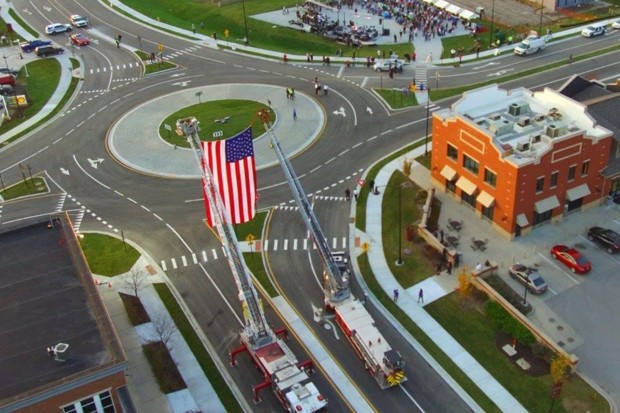
Folks who love that elegant traffic doughnut with a proven safety record—the roundabout—should consider relocating to Carmel, Indiana. The city recently debuted its 100th circular intersection, further solidifying its status as Exalted Roundabout Lord of the United States.
The intersection’s ribbon-cutting was marked with crowds, fireworks, live music, and a drone fly-over that captured the grass-centered ring in all its glory:
City of Carmel
“This marks a milestone in a 20-year initiative to transform a transportation network that had previously been littered with failing, traditional suburban traffic lights, four-way stops, and other poorly functioning, dangerous intersections,” the city crowed in a press release. “The network-wide incorporation of modern roundabouts has transformed Carmel’s roadways into a smooth-flowing network that has dramatically reduced accidents.” (Indeed, the Federal Highway Administration says roundabouts decrease severe traffic accidents by about 80 percent compared to intersections with traffic lights or stop signs.)
Carmel and its roundabout-loving mayor, Jim Brainard, have helped push Indiana into the big league of U.S. states deploying roundabouts, despite its smaller size compared to, say, Colorado or California. In terms of individual U.S. cities, it appears to have no equal in this regard, though Colorado Springs comes a little close, with around 70 roundabouts. Plus, its one roundabout per 890 residents gives Carmel a “not too shabby” rating for roundabouts per capita, according to Bill Baranowski of the delightful website RoundaboutsUSA.
“Here in Utah, Riverdale City, with a population of 8,400, has 7 roundabouts so per capita there are one roundabout per 1,200 citizens,” emails Baranowski. “Avon, Colorado, 6,447/13=495 almost double your Carmel ratio.”
Carmel believes its horde of roundabouts, which don’t require drivers to stop and start, save the city’s motorists about 24,000 gallons of gas annually for each roundabout. And with more than 30 new roundabouts planned in the next few years, the city will continue to reap the environmental and safety benefits of this curvy, low-speed traffic intervention. So why aren’t more places in the U.S. coming around to roundabouts?
Ken Sides, a transportation engineer at Sam Schwartz, has a theory about why America continues to embrace the “ugly, unpleasant, and dangerous seas of asphalt” that are conventional intersections.
“Just as a strong local champion can get roundabouts built, as in the case of Mayor Brainard, a lack of strong national championship might be [a] reason,” Sides says. “[The Federal Highway Administration] does list modern roundabouts as a ‘proven safety countermeasure,’ but lumps roundabouts in with nine other countermeasures. [The Institute of Transportation Engineers] styles itself as an international leader in traffic engineering, but has issued only a tepid statement in support of modern roundabouts, in spite of the tens of thousands being constructed worldwide.”
If the U.S. were to get serious about roundabouts, it’d have to pick up the pace significantly. “At a national level, the United States would need at least 145,000 modern roundabouts to achieve roundabout parity with either France or Australia,” Sides says. “If the U.S. builds 7,050 roundabouts per year for the next 20 years, it would then be… 20 years behind France and Australia.”
Oh, Nashville - we can do better. The recent piece on NPR about Nashville's Metro Codes being understaffed rings so true if you are someone who is highly interested in walking. Port-a-potties literally placed mid-sidewalk are, sadly, not terribly uncommon. Parking meters, also mid-sidewalk. Guide wires. Poles. All mid-sidewalk. No one is watching. No one is being held responsible. No fines collected. No corrections made.
Situations like this, of stuff in the middle of the sidewalk, should lead to a fine & correction. Preferably, a steep fine that is memorable to the contractor/developer & speedy repair.
NPR reports, with the provocative title of 'Metro Codes Is Understaffed And Handles Citizen Complaints With A ‘Skewed’ System, Consultants Find', that codes is 'understaffed and overwhelmed'.
'And it describes the system of responding to citizen complaints — about uncut grass, garbage in alleyways, and unsafe buildings — as “skewed more toward protecting the rights of property owners against unjustified complaints than it is toward providing relief to neighbors.”'
The consultants 'suggest several changes to add teeth to enforcement'.
If you live in Nashville, you know exactly what this means. You can call about an issue but then see the same thing pop-up on the next block over. It is EXHAUSTING to notice these things and make these calls/complaints. When you do call, you, as a citizen, are frequently asked to gather more information before action can be taken. In a city that is properly staffed, I don't think they would be asking you to do leg work. In Nashville, this asking for more, almost feels like a push-off. Like if they ask you for more, you'll just drop it. That is not the spirit and we can do better.