Monday, September 21, 2015

US Surgeon General Gets Involved in Walkability! Should neighborhoods be labled like cigarettes?


You may have wondered why I care so much about walking...well, it comes down to health.  Both physical health and psychological health.  As a physician in Nashville, I meet a lot of people who are unhealthy...and I have real concerns that part of their problem is our built environment.

In Nashville, 75% of our public roadways do not have sidewalks and 88% are described as dangerous for walkers. 

Is it any wonder that people do not walk?


This is in the heart of The Urban Service District in Nashville between the busy Green Hills area and Hillsboro Village.  An easily walkable distance... but would you walk here?


What if we labeled unwalkable neighborhoods like we do cigarettes?


9 Sep 2015 | Posted by Stephen Lee Davis |


The Surgeon General of the United States will unveil a bold new initiative today, aiming to help Americans lead healthier lives — by making walking and physical activity built-in features of more of our neighborhoods.


At a press conference at 10 a.m. this morning the U.S. Surgeon General will kick off a new national Call to Action, urging cities and towns to consider how the design of our roads and public spaces can encourage more walking by making it easier, safer and more convenient. (Tune into the live webcast of the event at 10 a.m. EDT.) To show how significant an issue this is to the Surgeon General, today’s announcement is only the sixth such Call to Action in the last 10 years.
surgeon general warning


According to the Surgeon General’s office, only half of American adults get enough physical activity to reduce the risk of chronic disease, and 10 percent of the preventable deaths in the United States are related to lack of physical activity. Communities that lack safe places to walk are a part of this problem.

What if we labeled unwalkable neighborhoods like we do cigarettes? A similar call from the Surgeon General in 1964 was the watershed event that kicked off a decades-long decline in cigarette use. Could today’s Call to Action do the same for communities without safe places to walk?

What if we put states, cities and towns on notice that streets and roads that are dangerous by design for people on foot or bike are a prime contributor to the obesity epidemic (as well as a contributing factor in an alarming number of fatalities)? What if we prioritized sidewalks and crosswalks the same way we do sunscreen, “no smoking” signs, and preventing underage drinking?

Help us celebrate this important step forward: share today’s announcement with friends and colleagues:

The Surgeon General’s position makes it clear that America needs more than a simple call to “get out and exercise.” We need to build communities where walking is a safe and convenient option — so getting where you need to go can help you stay physically active and healthy.

The good news is that the tide is turning in communities of all types and sizes all over the country. Small towns, rural, suburban and urban areas are reinvesting in their downtown cores and creating vibrant walkable neighborhoods like never before and reaping the benefits of better walking and biking infrastructure. We still need to do more to encourage walking, but there’s clearly huge pent-up demand for walkable neighborhoods and high-quality facilities that anyone can use.

People want to walk, and they increasingly want to live and work in places where it’s a convenient option.

Since Indianapolis’s Cultural Trail, a high-quality biking and walking trail, opened in 2008 the value of properties within a block have increased an astonishing 148 percent. Last week, the Atlanta-Journal Constitution published a special package about the amazing demand for homes near the still-in-progress Beltline project that will eventually encircle the city with trails and transit. Nashville’s metropolitan planning organization recently began considering health criteria as they select transportation projects in the hopes of helping improve the health of residents over the next few decades as they grow. Washington State adopted a Vision Zero plan to reduce pedestrian deaths to zero. Making their vision a reality includes not just educating drivers about pedestrian and bike safety but also re-designing streets and roads to slow traffic and give folks walking and biking safe and attractive facilities to use.

There’s far more to do, though. While these stories are encouraging, the lowest-income neighborhoods across the country are the ones more likely to lack sidewalks, crosswalks or other facilities to keep residents safe.

Help celebrate this important call to action. Share this post and image with your friends and family and colleagues.

LINK:
http://www.t4america.org/2015/09/09/what-if-we-labeled-unwalkable-neighborhoods-like-we-do-cigarettes/


Sunday, September 20, 2015

Unique and Powerful Intervention...With Flowers.


One thing worth fighting is good design.  When it comes to sidewalks and bikelanes, if there is an intrinsic flaw in the design, it can be dangerous, little used, expensive and permanent. 

Consider sidewalks built directly next to high speed roads without any green buffer.  


New 1.4 mile stretch on Harding Place near I-24.  Imagine walking here with small 
children.  Cars are zipping by at 40 miles per hour on their way to the expressway.

One false step and your child is in the road.

Now, imagine if there was a few feet of green buffer - essentially a strip of grass and trees that separate you from the traffic.  Psychologically, this is a significant difference and a much safer (and cooler - literally cooler with the shade created) environment to spend time on foot.

Contrast the above image with the next image that includes a green buffer.
See the difference?

Understandably, the later project, with the green buffer, is likely more expensive but with the permanency of such projects and the cost involved, shouldn't our goal be to build the better designed project  so that people actually use it?

***

I like this guys take on a similar problem.  


A Guerrilla Bike Lane Made With Flower Pots Forces A City's Hand

A cyclist in Boston was sick of a dangerous stretch of road that the city refused to fix, so he took on the matter himself.
For Boston cyclists, Massachusetts Avenue can be a terrifying place to ride—drivers routinely ignore the stripes marking the bike lane and swerve into the path of bikes. After a truck driver recently killed one young bike commuter, the city promised to add some simple barriers to the lane. But they were slow to act.
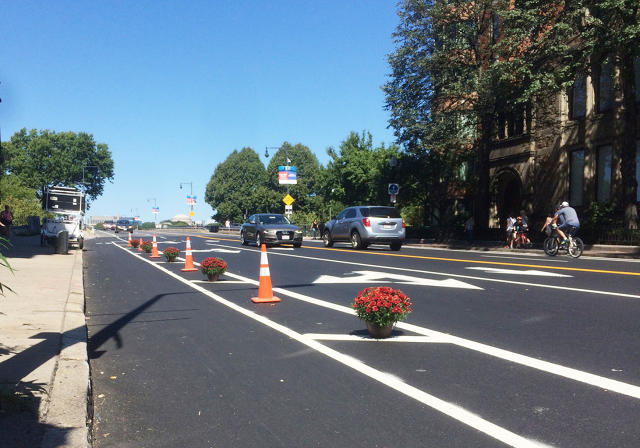
So another bike commuter decided to take on the problem himself: On his way to work in Harvard Square, Jonathan Fertig dropped off a line of orange construction cones and potted flowers along the edge of the bike lane.
"I've been growing increasingly frustrated over the past year," says Fertig, who saw progress on bike infrastructure in the city start to slow when a new mayor came into office.
"When a young woman was killed by a truck driver last month while riding the route that I ride every day it hit me in an unexpectedly personal way," he says. "I was searching for a way that I could do something to amplify to fury that many of us in the walking and cycling advocacy community were feeling."
He picked up a copy of Tactical Urbanism, a book that lays out urban interventions like DIY bike lanes. Inspired, he "just decided to drop some cones in the buffer of the newly installed bike lane. In an instant, cars were no longer using the bike lane as a turning lane."
The flowers have a symbolic connection to the memorial at the corner, where a ghost bike has a flower-filled basket. "Flowers are also beautiful and entirely non-confrontational in their own right," Fertig says. "I liked the concept of using them in an act of civil disobedience. ... I am a child of hippies, after all."
The intervention worked—at least for a small stretch of the road. "It's a joy for 200 feet, until you reach the corner where the terror resumes," he says. "I've had countless people tell me online that the intervention made a big difference."
Less than a week after he installed the cones and flowers, the city came out to add flexible posts (they still have yet to paint the lane green or add green bike boxes, two other promises the transportation department made). But Fertig, like many other cyclists in the area, thinks the lane could be much safer—and probably should be fully separated with a permanent barrier.
He also wanted to draw attention to how slow the city was to act. "While re-engineering the intersection in any capacity within a month would typically be considered a very quick response, they only did so because of the fatality, and it was thus reactionary," he says. "The city—and the advocates that helped crunch the data—have known for two years that the intersection has one of the highest crash rates for cyclists and pedestrians in the whole city, yet they had done nothing."
As a continuing protest, he added more flowers to the new flexible posts.
He's also raising money to add more interventions down Massachusetts Avenue—which he calls the most dangerous stretch of road in the city. In the first two days, the campaign raised more than $3,000.


LINK:

Saturday, September 19, 2015

AMAZING IDEA! Reflective paint never looked so great!

I am in LOVE!


While waiting for Nashville to build roads that are safe for all...this is a wonderful idea for pedestrians too.

***  


And, remember to walk AGAINST TRAFFIC when on foot in areas without sidewalks (75% of Nashville's roads lack sidewalks) for best visibility and the highest level of safety.  


LINK:

https://www.youtube.com/watch?v=oaLP4iGszLQ

FYI:
Albedo 100 Reflective Spray Invisible Bright is a very similar product for sale on Amazon.


Friday, September 18, 2015

#DontBlockMyWalk at Walk/Bike Nashville


#DontBlockMyWalk

Walk Bike Nashville is currently running a campaign with the name #DontBlockMyWalk which is a quick way to help advocate for better walkability in Nashville.  


***

In addition to construction blocking sidewalks, there are a number of repeated offenses by citizens and businesses leading to blocked  pedestrians thoroughfares.

 The corner of 24th S and Blakemore (at Dragon Park) is a location that continues to frustrate me as there is almost always a car parked smack in the middle of the crosswalk.  Although not a blocked sidewalk per se, you can see that this disallows free mobility on foot.  Worse, if you are using a stroller or wheel chair, the curb cut is completely blocked off. 


This kind of blockage seems to be in the same spirit as the campaign and deserves attention.


Walk Bike Nashville's excellent advice:

If you see a sidewalk that is closed with no safe, alternative route please share it on social media with the hashtag #DontBlockMyWalk.  Give the address or cross street.   You can also consider adding the location and tagging Walk Bike Nashville (@walkbikenash), Metro Public Works (@NashvillePW) and the Mayor's Office (@MOON_Nashville). Also consider tagging your district and at-large council members to let them know that this is a concern. If you don't use social media, you can also still email your council member to let them know of your concern.  


Additional Steps:

- Call Non-Emergency Police (615-862-8600) --- to report issue, ask for ticketing.  They will need address or cross streets.  If it is a car blocking, they will need the make, model and color of car.  Best to have plates, too.
- Call the police precinct of the area to ask for extra patrol if issue is persistent 
- Public works takes calls (615-862-8750) and emails (http://www.nashville.gov/Public-Works.aspx with photos) as well  Best to have as many details as possible. 

Unless these entities know that you care about walkability issues, don't expect much to change.


***

Two additional and frequently spotted issues in Nashville:

1) Cars parked on sidewalks
2) Trash buggies on sidewalks


Any large obstacle on the sidewalk means walkers are going to have to risk safety and go into the road. I encourage you to notice anything that blocks your walk and report it.  


***

The fact is, everyone in Nashville is a pedestrian.  Yet, unlike cyclist, we are a group that is not especially advocate minded.  In regards to pedestrians, we have allowed Nashville to become the 15th most dangerous city in the US and a place where 88% of our public roadways are not safe.  

***


Thursday, September 17, 2015

Car-less Campaign Here in Nashville! Are you willing to take the pledge?

Must be shared...Maybe your neighborhood is next?


This Nashville neighborhood is ditching its cars for a week

Sep 16, 2015, 1:25pm CDT


Scott HarrisonStaff ReporterNashville Business Journal


One Nashville neighborhood is pledging to leave their cars in the driveway, or curbside, next week.


The Nations Neighborhood Association is launching its “Don’t Car Campaign” starting this weekend. More than 30 members of the West Nashville neighborhood will go without their cars from Sept. 19 to Sept. 25.
Enlarge


Several residents of The Nations have pledged to give up their cars for a week.

INGRAM PUBLISHING

Jamie Brown, an attorney with Bass Berry & Sims and member of the Nations Neighborhood Association board, said the idea started from the new developments going on in the area.


The residential density is getting higher. One [house] goes down and two or three go up,” she said. “Now we’re starting to see condominium and apartment units.“


“Parking has been a big issue here,” Brown added. “We’re worried about how [new development] is going to affect our overflow parking in the street. We don’t have sidewalks in our neighborhood. The developers keep telling us this is a walkable neighborhood, saying it’s close to downtown. … We wanted to test that concept.”


The Nations’ car-less campaign touches on a few hot-button issues that Nashville’s frantic real estate development boom and economic growth have brought to the forefront: An existing mass-transit system that is deemed by Nashville MTA to be inadequate for the city’s expanding population. That goes hand-in-hand with the general walkability of the city’s neighborhoods, not to mention bike lanes.

As Brown describes it, the campaign is meant to do several things. For starters, the Nations neighborhood group hopes it will spread to other communities in Nashville.


“People in other neighborhoods have reached out and told us this is a great idea,” Brown said. “We hope the campaign could be done by other neighborhoods.”

The group wants to challenge transportation norms and test the limits of public transportation within the Nations, whether it’s getting downtown for work or running to the store for groceries. Those participating in the campaign will also be documenting their experiences.

Brown recently moved back to Nashville in 2013, after going to law school from 2007 to 2010. She says she has a few plans to get work at downtown’s Pinnacle building next week.


http://www.bizjournals.com/nashville/blog/2015/09/this-nashville-neighborhood-is-ditching-its-cars.html


Sunday, August 30, 2015

TN is the LEAST Active State in the Nation. 88% of Nashville's Roads are UNSAFE for Pedestrians...See the Connection?

Tennessee is the LEAST active state in the nation and 88% of Nashville's roads are unsafe for pedestrians and bike riders...


Tennessee's obesity rate is over 30%.  


If you see the connection...you will understand why it is critical to ask local and state leaders to fund the highest quality sidewalks possible.


The Nashville Area MPO: Linking transportation & public health


How setting criteria for project selection transformed a regional transportation plan


Over the last several years, Nashville’s regional leaders have been trailblazers in using health indicators as one key screen for choosing projects marked by their 2035 Regional Transportation Plan. The focus on the connection between transportation and public health transformed their plan; where in the previous plan approximately 2 percent of projects incorporated features to provide safe walking and biking, in the most recent version nearly 70 percent include those elements.


The journey toward identifying and adopting the criteria they would use to select projects involved blazing their own path in an emerging practice.

They went beyond the typical practice of Metropolitan Planning Organizations (MPOs) in considering health only in regards to air quality and road safety. Instead, they began to also recognize a much broader interplay of transportation and public health by considering the role of transportation in increasing physical activity and access to destinations (e.g. employment centers and healthcare facilities), and in improving overall quality of life.


Flickr photo by Prayitno. https://www.flickr.com/photos/prayitnophotography/17180174647/
A public health crisis and a clear public vote of confidence

The story of how the five-county Nashville Area MPO (pop. 1.5 million) became a leader in using health-related criteria to shape its Regional Transportation Plan begins in the late 2000s with a recognized public health crisis.Tennessee is the least active state in the nation with 61 percent of adults failing to get adequate physical activity. Safe streets and sidewalks for walking or bicycling are in short supply across the broader Nashville region. A 2009 study by the MPO found that 88 percent of the region’s roads were unsafe for people on foot or bicycle.


The eye-opening results of a 2010 MPO attitudinal survey of residents helped push the The Nashville MPO toward this eventual shift in policy toward using health-related criteria to shape their long-term plan and select projects, revealing deep public support for increasing opportunities to use public transportation options and safely walk or bike around the region.

In this survey of 1,100 randomly selected households, Nashville region residents voiced the greatest support for providing more public transit, followed by increasing active transportation (walking and biking) options, and also for preserving existing roadways and adding sidewalks. The MPO then moved on to developing a process to score and select transportation projects to address the desire from the public for having more of these facilities, with improving residents’ health as a central component.


Photos courtesy of Stacy Proctor, The Shade Parade. http://shadeparadenashville.blogspot.com

When the MPO began considering goals for its 2035 plan (adopted in 2010), the staff and leadership considered health concerns beyond obesity to include asthma and other air-quality related diseases, traffic injuries and health conditions associated with lack of exercise. In considering health along with other quality of life goals, they found substantial overlap with solutions for economic and environmental sustainability.

The MPO developed four desired outcomes from transportation investment with links to public health and well-being: (1) levels of physical activity, (2) air quality, (3) safety and (4) and addressing disparate impacts on vulnerable or disadvantaged populations, including children, the elderly and low-income neighborhoods.

The MPO then zeroed in on several core objectives:
Investing in communities to provide a safe and convenient option for walking and biking.
Investing in building a modern regional transit network.
Adopting a “fix-it-first” approach that emphasizes repair and improvement of existing roads before constructing new ones.
Shifting investment strategies towards a diversity of transportation options, rather than sole focus on road capacity.
Use transportation improvements to develop a sense of place (not explicitly referred to in the 2035 plan, but a focus of the MPO’s ongoing efforts).

All of these changes in process came from the understanding that the way communities are designed and their transportation systems have substantial impacts on the health and well being of their residents.
Matching funding to new priorities

Over the course of the next 25 years a substantial portion of the MPO’s $7 billion transportation budget is targeted towards expanding the active transportation network in Middle Tennessee.

The MPO’s largest source of federal funds comes from what’s known as the Surface Transportation Program. The Nashville Area MPO is dedicating 15 percent of those STP funds to their newly-created Active Transportation Program (ATP) for bicycle and pedestrian infrastructure, another 10 percent to match Federal Transit Administration funds for supporting transit investments, and additional STP funds toward projects that incorporate Complete Streets elements.

All told, under the 2035 Regional Transportation Plan, 70 percent of the adopted roadway projects include active transportation infrastructure.
Scoring and evaluating projects

In scoring projects for possible funding, MPO officials are assigning more points to those that promote physical activity in existing communities, as well as those that provide multimodal access and connections, and that improve the conditions for people on foot.

In calculating project benefits, areas with more vulnerable residents (health-wise) benefit the most from having new opportunities to walk or bike safely. Health disparities tend to be highest in areas that are more economically disadvantaged, which the MPO measured by determining the areas that have a larger percentage Hispanic and minority populations, higher rates of poverty, physical disability, single parent households, zero-car households, and areas with higher percentages of people that have limited English proficiency.


Under the scoring system, 60 percent of the criteria relate to elements of active transportation, health, the environment, safety and congestion. The congestion score is weighted in favor of project that can improve health through additional non-motorized road capacity (i.e, sidewalks and bike lanes, etc.), safety (i.e. crosswalks, bump-outs, etc) and navigation enhancements for people using non-motorized modes.

To measure progress and assess what’s having an impact and where on the health of Nashville residents, the MPO is collecting data to provide baseline evidence for policy benchmarking and, over time, provide a measuring stick.
Giving the people what they want

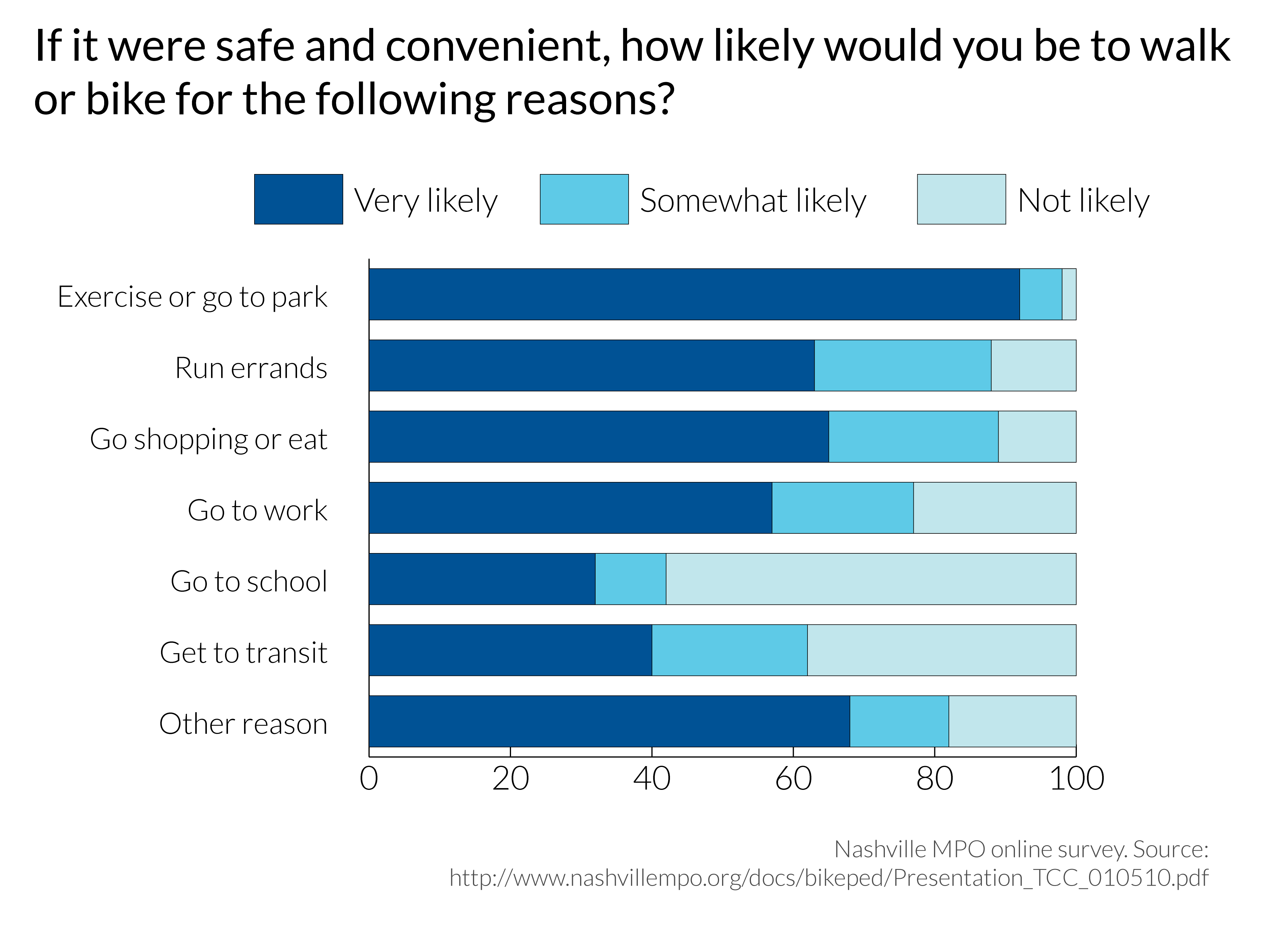
Nashville area residents react positively to the idea of safer and more convenient walking and biking infrastructure. Even with current inadequacies in walking and bicycling facilities in the MPO’s area, 92 percent of the surveyed public would be willing to use bicycle and pedestrian infrastructure to exercise or go to a park; 66 percent to shop or eat out; 65 percent to run errands; and 55 percent to bike and walk to work if it were safe and convenient, according to this survey from the MPO.


The Nashville Area MPO’s new criteria for scoring and choosing projects have transformed the project selection process by providing a far more holistic analysis of the benefits created by each transportation project and how projects compared to the hundreds of others competing for federal funds. With limited resources available to support transportation investment, the Nashville Area MPO elevates projects that score the highest on multiple objectives, with health and equity serving as important components in that evaluation process.

To view the Project Evaluation Criteria that the Nashville Area MPO used in the 2035 Regional Transportation Plan, visit the following link: http://nashvillempo.org/docs/lrtp/2035rtp/Docs/MPO_Scoring_031710.pdf

To view the entire 2035 Regional Transportation Plan: http://www.nashvillempo.org/docs/lrtp/2035rtp/Docs/2035_Doc/2035Plan_Complete.pdf


Thursday, August 27, 2015

All too Common Scene in Nashville - The Issue with Right Turns


All too common scene in Nashville:  picture a beautiful day.  Woman walking briskly down the street approaching an intersection.  White car, also moving briskly down the street in the same direction (same side of the street).  Walker starts to cross the street - takes one step off the curb as she is going straight through the intersection.  Woman in white car turns right, directly in front of the pedestrian (who has already taken a step into the road).  Walker leaps backwards and throws up her arms.   White car continues her turn and then pulls into near by parking lot.   


Yield to walkers when turning your vehicle.
Right turns are particularly problamatic, most notably at green lights, as both the walker and the driver are getting the walk sign and green light respectively.


Me:  ' Excuse me, sorry to bother you, I volunteer with a walking advocacy group (Walk Bike Nashville) and I noticed that you turned directly in front of that woman back there trying to cross the street'.

Woman in the White Car: 'Oh, I just thought she was standing on the corner'.

Me: (under my breath) 'Who just stands on a corner'?  (more audibly) 'No, she was trying to cross and you turned directly in front of her.  I just wanted you to know that she had the right-of-way'.

Woman in the White Car:  'I thought I had the right-of-way since I was driving'.

Me: 'No, the pedestrian always has the right-of-way'.

***


I would argue that Nashville needs 2 things desperately:

1.  Drivers need to know the law.  
---If a pedestrian is in the road, you are to yield to them.  It is a drivers job to anticipate the moves of pedestrians.  Think about it:  in regards to safety, as a driver, you are thousands of pounds of metal hurtling through space with the only effort being putting your foot on the gas.  A walker, is skin and bones and is locomoting by their own muscle.  Be aware of them!  Give them space!  Yield to them!  Anticipate their movements!  If they are walking briskly towards a corner, expect that they are crossing and slow down!
---Improved knowledge of the law could be accomplished by an agressive public awareness campaign
---This should also be a significant part of the exam to get a license

2. Drivers should be ticketed if they endanger or hinder pedestrians
 ---Now, I am not talking about risky moves made by pedestrians such as darting out from inbetween cars.  This is definitely the action of someone who is taking a big chance that a driver will see them and be able to slow.  
---That being said, if you are driving in a residential neighborhood or active business district with obvious pedestrians (i.e.:  people walking, signs that say Drive Like Your Children (or Pet) Live Here) - drivers should expect pedestrians and slow down!  This kind of activity is fair warning that a driver needs to be on high alert.
---Drivers should be ticketed for not using their turn signals at intersections as this limits communication between the driver and the pedestrian (and is the law)
---Drivers should be ticketed for driving too fast when pedestrians are present (this is also the law)
---Drivers should be ticketed for parking in crosswalks (this is, yet again, the law)
---Drivers should be ticketed if they do not yield to pedestrians.  A major job of anyone behind the wheel is to be observant and anticipate the moves of others (particularly vulnerable pedestrians!  Once more, the law people)
---One thing that should be added to the law:  giving pedestrians 3'  of space (at least) if they are in the road without proper pedestrian infrastructure (this is critical in Nashville!)

I watched a man out walking his dog have to wiggle around this vehicle in the middle of the crosswalk and peer around the trailer in order to cross safely.  Like a fire hydrant, you cannot park in or near a crosswalk.  It is a drivers job to know this!

If you see something like this PLEASE call non-emergency police and they can come out and ticket.  If enough people call, we can raise needed awareness and start chipping away at this very important barrier to walkability in Nashville.


---One quick note to pedestrians:  you are supposed to walk AGAINST traffic if on a road without sidewalks for your safety!


  Shade Parade Nashville advocates for better walkability mostly through high quality well designed sidewalk infrastructure.