Recently, I had the pleasure to meet The Music City Riders United group whose advocacy work is focused on better public transit in our city.
Soon after, I had a fund raising dinner party for The Sidewalk Foundation and a deep thinking native Nashvillian friend said, 'walking is the most basic form of public transportation'. We were discussing, to our eyes, one of the reasons the Transit Referendum did not pass: citizens cannot figure how to get to the bus on foot or where it would be safe and comfortable to wait for it.
People walking to the Bus on Sharondale and Hillsboro
My Bus Stop
Then, I was listening to the former NYC Traffic Commissioner Sam Schwartz on Fresh Air (NPR, Terry Gross, LINK for full interview) and thought, he nailed Nashville with this description:
'There are bad public transportation systems out there. 90% of the country has lousy public transportation. It's called a bus that comes around every 1/2 hour or hour. It largely serves poor people. When a system only serves poor people, it's a poor system'.
Good news, we are not alone, I guess.
Add to this, missing sidewalks on 80% of Nashville's roads (AKA no safe way to walk to the bus) and you get a severely under-utilized public transportation system in the setting of mounting traffic as our city grows.
Nashville, this needs to change.
Other cities have made a commitment putting pedestrians first and Nashville could too. Sidewalks need to go in as a first step. Naturally, then, public transportation use would grow and traffic could be reduced.
'Many scientist have one big idea, which they stick with throughout their career,' writes Daniel M. Davis in The Beautiful Cure. I feel this way about sidewalks for Nashville.
'Above all [scientists] aren't afraid of being wrong'. These thoughts, in this blog, are my own. I am passionate about helping Nashville transform into a great walking city for the health and safety of its citizens. This work is voluntary and therefore I may not have all the facts correct from every angle. What is presented, I believe to be accurate and fair.
It is always difficult to know when to speak up when it comes to sidewalks and walkability here in Nashville. Despite a common sense of desire for and commitment to the ideal of a great walking city, the actual progress feels glacial.
Former NYC traffic commissioner Sam Schwartz has written a book entitled No One at the Wheel and he raised a number of interesting points for your consideration during a recent interview on Fresh Air (NPR, Terry Gross, see link below for full interview). These points speak directly to many of my deepest concerns about the way Nashville is: a car dominate city which is taking small measured steps toward walkability & public transportation. We are definitely not being bold.
Despite discussion in the past of 'Zero Tolerance' for pedestrian deaths, we continue, year by year to beat our prior record (Nashville Pedestrian Death Registry).
Progress is made on NEW sidewalk production but very slowly. After 5 years of volunteering on this topic alone (The Sidewalk Foundation, #FoundOnFoot, Shade Parade), one still cannot walk from point A to B appreciably safer, quicker or more comfortably.
The interview with Sam Schwartz, former NYC traffic commission highlighted a few key points which I quote and illustrate here.
1) 'I’d like to change the mindset a bit and remember that for hundreds of thousands of years – since the first cities started – it was the pedestrians that were walking and the carriages had to go around them or move at that the same speed. Somehow we have accepted the idea that we need lots of cars, lots of vehicles, and the intruders are the bike riders and the pedestrians and they should be 2nd class citizens.
Nothing makes you feel more 2nd class than literally having no place to walk
2) 'The car is not the villain', JFK. 'BUT, what JFK was calling for was balanced transportation.
'And, that’s what I am calling for. What we need is a better balance...The
pendulum swung in the direction of too many people driving…There is a better
way'.
3) 'What happened in cities like NYC, Seattle and others that
really went, I wouldn’t say all out, but at least in the central business
districts provide far more pedestrian zones, far more bike lanes, the total
number of cars coming in has gone down. We can get by with fewer
cars. If we get by with fewer cars, then maybe Chestnut and Walnut in
Philadelphia could have different uses. Maybe the cars go very slowly
which they do anyhow.If you go to many European cities, you’ll see the
mix of pedestrians and cars moving very slowly. We may be able to
use examples like that but we have to change our mindset'.
There is zero need to go faster than 20mph on local/residential streets or when pedestrians are present! This is also an argument for parking once - then running the remainder of your errands on foot. This could be the desirable choice IF there is a safe walkable option.
4) ‘Disappointed with the auto-industry reflecting people’s
desires to be in bigger cars and to have these front ends that are so
high. That has an impact. That’s why pedestrian deaths – one of the
main reasons pedestrian deaths have soared is that people are getting hit by
SUVS. People are no longer getting hit and developing knee injuries
but, and this comes from ER physicians, who note a connection. In
the past, someone hit by a car had a knee injury or a leg injury. Now,
it’s a chest injury and more likely to be fatal'.
5) 'There are bad public transportation systems out there. 90% of the country has lousy public transportation. It's called a bus that comes around every 1/2 hour or hour. It largely serves poor people. When a system only serves poor people, it's a poor system. Often it's largely people of color. We have an opportunity to transform public transportation in those areas - not to offer 1/2 hours service - but we could triple the service by using micro-transit autonomous vehicle. Small buses that are on demand that know where the people are'.
These are all major issues in Nashville that add to traffic and decreased QOL as they reduce pedestrian comfort and safety. These factors all have an impact.
Walking is the most elemental form of mobility and sidewalks are a basic ingredient in a thriving public transportation system. Without sidewalks, many cannot access the transportation system, such as the bus, safely or simply.
Without sidewalks, there is a barrier to use the bus.
This is why I was so happy to be invited to talk with the Music City Riders United (https://workersdignity.nationbuilder.com/mcru17). This group is working hard to make riding the bus a better and more practical experience.
I shared with them a few critical sidewalk facts that make riding the bus difficult for many.
- 81% of Nashville's roadways do not have a sidewalk
Last night, I went with my family to see Steve Winter talk about photographing big cats for National Geographic. It was completely enthralling. One of the most striking things he spoke of was a land bridge, to cross the 101 freeway in Los Angeles, to allow mountain lions safe passage and access to a much larger terrain.
This project is being spearheaded by volunteers and by private donation.
***
To build a bridge for mountain lions, wildlife activists need $60 million
As 101 Freeway traffic streaked past, a dozen conservationists and fundraisers gathered this week just west of Liberty Canyon Road in Agoura Hills, their eyes alternating between maps they carried and the contours of a canyon where mountain lions hunt and breed.
But it wasn’t the big cats they were looking for. Their target, instead, was a patch of land that could anchor a 200-foot-long, 165-foot-wide overpass spanning a stretch of freeway that carries 100,000 vehicles each day. Click 1st link for remainder of article.
***
This topic, sat with me in part because of my persistent interest in the safety and health of pedestrians in Nashville.
Nashville is a large city/county of over 500 square miles. We have 19% of its streets sidewalked. At our current rate of production, none alive today will see this job done.
The notion of private funding major projects like the land bridge above is being done in other cities and it raises the notion of doing it in Nashville to build sidewalks.
Other cities have reduced their speed limits on local streets as part of Vision Zero.
Could Nashville?
***
Maybe we shift gears from Walking Districts to the creation of Walking Cities. Speed limit reduction could go a long way to helping pedestrians feel safe and be safe.
Interesting read...most buy SUVs for the look, space and the safety (their own). 'SUVs, with their higher front-end profile, are at least twice as likely as cars to kill the walkers, joggers and children they hit'. This is a new angle to consider - how these vehicles effect the safety of others particularly those on foot.
As someone highly interested in tracking these deaths, see https://www.nashvillepedestriandeathregistry.org/, the type of vehicle driven should be listed in the data collected on each pedestrian death.
This picture says it all. Everything is geared to the person IN THE CAR and NOT someone on foot. The width of the road, the height of the signage. This is NOT a safe or healthy place for a pedestrian.
Death on foot: America's love of SUVs is killing pedestrians America's love for SUVs is killing pedestrians, and federal safety regulators have known for years.
Eric D. Lawrence, Nathan Bomey and Kristi Tanner, Detroit Free Press/USA TODAY NETWORK
7:30 PM June 29, 2018
Highlights from the article:
Almost 6,000 pedestrians died on or along U.S. roads in 2016 alone — nearly as many Americans as have died in combat in Iraq and Afghanistan since 2002. Data analyses by the Free Press/USA TODAY and others show that SUVs are the constant in the increase and account for a steadily growing proportion of deaths.
Their investigation found:
Federal safety regulators have known for years that SUVs, with their higher front-end profile, are at least twice as likely as cars to kill the walkers, joggers and children they hit, yet have done little to reduce deaths or publicize the danger.
A federal proposal to factor pedestrians into vehicle safety ratings has stalled, with opposition from some automakers.
The rising tide of pedestrian deaths is primarily an urban plague that kills minorities at a disproportionate rate.
It is most prominent in cities both in the industrial heartland and warm-weather spots on the nation’s coasts and Sun Belt. Detroit; Newark, New Jersey; St. Louis; Baton Rouge, Louisiana; Miami, San Bernardino, California, Birmingham, Alabama; Tampa; Fayetteville, North Carolina; and Phoenix had the 10 highest per-capita death rates among cities with populations of at least 200,000 in 2009-16.
Look at the grill height. You can see, that if struck, how much more damaging an SUV would be to your vital organs.
The Insurance Institute for Highway Safety calculated an 81 percent increase in single-vehicle pedestrian fatalities involving SUVs in 2009-16. The Free Press/USA TODAY analysis of the same federal data, counting vehicles that struck and killed pedestrians rather than the number of people killed, showed a 69 percent increase in SUV involvement.
'Pedestrians are 2-3 x more likely to suffer a fatality when struck by an SUV or pickup truck than when struck by a passenger car'
Incredibly proud that this work is being used for further research and to spark discussion. We need this.
Nashville Pedestrian Death Registry.org was created spring 2017 as a joint project to further investigation of how people die while walking in our city. As with most things, the more you learn about the subject, the more complicated and interesting it becomes...
Anthony and I both knew that the stories were more detailed compared to what we read in news and police reports. The map of pedestrian deaths is also very different from what we were hearing as assumed trouble spots.
Favorite quotes from article from NPR below:
45 percent of pedestrian fatalities go unreported in local news outlets, and that when they do, the details provided by police and journalists may be contributing to misperceptions about why pedestrians die.
Last year was the deadliest on record for the city, with 23 killed
Initial traffic crash reports don’t seek many details about victims on foot — often only whether the person was in a crosswalk or wearing dark clothing. Those limited details, without more context, could lead to “victim blaming”
The researchers examined news articles, finding them “jarringly” formulaic, often completely composed of the routine facts that are included in federal crash reporting forms. That can leave out details about the victim, and context about the quality of sidewalks and crosswalks, street lighting, other infrastructure and road conditions.
“Media plays a big part in how we have public perceptions about public safety issues,” Robinson said, adding, “there’s very little coverage of infrastructure at all.”
TSU Researchers: Pedestrian Deaths Are Misunderstood, In Part Because Of Police And Journalists
6/27/2018
Researchers at Tennessee State University say they’ve found shortcomings in how pedestrian deaths are documented and reported through local news outlets.
In a study presented Tuesday (PDF), the pair of researchers said they found that roughly 45 percent of pedestrian fatalities go unreported in local news outlets, and that when they do, the details provided by police and journalists may be contributing to misperceptions about why pedestrians die.
Anthony Campbell, assistant professor of public administration, said he decided to investigate walking deaths because he’d picked up on some misunderstandings while compiling stories of local victims for the Nashville Pedestrian Death Registry.
Last year was the deadliest on record for the city, with 23 killed.
Anecdotally, people didn’t understand where these were happening, or why.
“People tend to say, ‘Oh, well, down on Broadway or something? People get drunk, come here …’ ” he said. “And that’s not. None happen there. Mainly because cars aren’t going fast enough. And then when you look where we found deaths are occurring are out at the perimeter, where people are having to walk home or go from point A to point B and there isn’t a sidewalk.”
Stats provided last year by Walk Bike Nashville show the most deaths (12) occurred on Old Hickory Boulevard, followed by Gallatin and Main Street in East Nashville (11), Murfreesboro Pike (11) and Nolensville Pike (8).
To read the remainder of the article, please click on link above
***
If you know someone who has perished on foot in Nashville, please contact us. We would like to talk to you.
I'm so excited to help spread the word that on Tuesday, June 26th, 2018, Anthony Campbell is giving an important talk about how pedestrian deaths are reported in the media.
This has been a hot topic in the pedestrian advocacy world as so often the factual details of what occurred are reduced to 1) was the pedestrian in a crosswalk, 2) was the pedestrian wearing dark clothing and 3) was alcohol or drugs involved. He and I both felt strongly there must be a deeper story with these deaths, more complex, and leaning heavily on how people actually live crossed with infrastructure and policy. With this in mind, we started Nashville Pedestrian Death Registry to track these deaths in Nashville.
Now, Anthony, along with Cara Robinson, have developed a talk entitled Dying While Walking: Interrogating Media Coverage of Pedestrian Deaths in the United States. Anthony is an Assistant Professor in the Department of Public Administration at Tennessee State University, a good friend and my partner at Nashville Pedestrian Death Registry.org. His research focuses on the lived experience of citizen-government relationships and the qualitative dimensions of how humans interact with the built environment. As an avid cyclist, Anthony has first-hand exposure to the importance of a safe transportation infrastructure.
I'm so pleased and proud of the work he is accomplishing and hope you will make time for this interesting talk.
Date and Time
Description
Join us for the presentation, Dying While Walking: Interrogating Media Coverage of Pedestrian Deaths in the United States by Anthony Campbell, PhD and Cara Robinson, PhD of Tennessee State University's College of Public Service (description below).
Bring your own lunch and meet us at the Avon Williams campus of Tennessee State University campus in Training Room #2 from noon to 1pm. See you there!
In recent years, a wide array of policy and technological innovations have been introduced in order to lower individuals’ risk of dying while driving. At the same time, there has been an increased risk of dying while walking. According to the Governor’s Highway Safety Association (GHSA), the number of pedestrians killed in the U.S. had the biggest ever single-year increase in 2016 – 5,997 (an 11% increase from 2015). Moreover, there was a nearly 25% increase in the 5-year span from 2012 to 2016. This increase in pedestrian deaths has resulted in public and nonprofit organizations developing strategies to improve pedestrian safety. One of those strategies has been the widespread deployment of educational campaigns to raise awareness about pedestrian deaths and ways to enhance safety. Juxtaposed to these campaigns has been the media’s coverage of pedestrian deaths, which are largely a product of police reports. Given the theoretical models related to the media’s disproportionate impact on public opinions, as well as the media’s and public’s impact on public policy decisions, it is necessary to interrogate how the media impacts the portrayal of pedestrian deaths in the United States. Utilizing media content analysis, and drawing upon media reports (from 2012 to 2016) in five large U.S. cities and one county, this research helps illuminate the role the media plays in constructing the narratives surrounding pedestrian deaths, and ultimately pedestrian safety. These narratives impact urban design and public policy decision-making related to pedestrian infrastructure and public safety. The media’s coverage of pedestrian deaths deserves interrogation, because as Malcom X powerfully avers, “The media's the most powerful entity on earth. They have the power to make the innocent guilty and to make the guilty innocent, and that's power.
NASHVILLE, Tenn. (WKRN) - Two women on scooters were critically injured after a hit-and-run crash in downtown Nashville.
Officers responded to the call at Union Street and Fifth Avenue Sunday evening.
Police said the victims, a 27-year-old and a 28-year-old, were riding Bird Ride Scooters northbound on Fifth Avenue when a car, going westbound on Union Street, struck both riders.
Copyright 2018 Nexstar Broadcasting, Inc. All rights reserved. This material may not be published, broadcast, rewritten, or redistributed.
(Photo: WKRN)
Both women were taken to Vanderbilt University Medical Center.
Police officials confirmed they called the fatal accident team in as a precaution.
The driver was last seen driving a black Lexus. Police said it sustained noticeable front-end damage.
Police said there are conflicting reports as to whether the Lexus or the scooter riders had the red light at the time.
Police said neither women was wearing a helmet at the time.
Anyone with information on the crash is urged to call Crime Stoppers at 615-74-CRIME.
Bird Scooters is a new business that rents scooters with electric motors in downtown Nashville. The company is based in Venice, California, and advertises environmentally friendly transportation.
Copyright 2018 Nexstar Broadcasting, Inc. All rights reserved. This material may not be published, broadcast, rewritten, or redistributed.
(Photo: WKRN)
Company spokesman Kenneth Baer released a statement about the incident, saying, "Our hearts go out to those impacted by the car accident today in Nashville in which two Bird riders were injured. According to published news reports, the riders were crossing a crosswalk while a motorist ran a red light, struck the riders, and fled the scene. Rider safety is a top priority at Bird, and we will work closely with law enforcement on the investigation."
Last week there were complaints about scooters obstructing the right-of-way downtown. The mayor said he wants to come up with some new ordinances to address potential problems.
"We appreciate innovation that helps people move around the city, but it's improper to obstruct the right-of-way without a permit. With no ordinances, or agreements in place with Bird, Metro has reached out to the company to amicably resolve the situation."
The investigation into Sunday's hit-and-run crash remains under investigation.
A great resolution as it is doable and healthy is to commit to a 30 minute walk per day.
If you do this on Nashville's city streets, you will quickly identify the issues our pedestrians face: lack of logical connected infrastructure, safety concerns, distracted drivers, poor lighting conditions.
Walking 30 minutes per day would turn us all into pedestrian advocates as the full menu of our issues would be quickly understood by all.
As health and safety are 2 major themes of this blog, I am wishing you a 30-minutes-per-day ACTIVE new year (per CDC guidelines) but encouraging you to be safe while on foot.
***
Please read the stories of those pedestrians who have lost their lives walking in Nashville.
Nashville is a creative town. Lots of artist use walking as a way to work out any complex knot they have worked themselves into. I recently read Stephen King's On Writing and was riveted by the spooky story from his real life of being struck by a van in 1999 while taking his daily 4 mile walk in Maine.
I recognized instantly his description of walking on roadways with narrow shoulders and no sidewalks. All it takes is one distracted driver...
This is my own spooky spot. As I head north on 23rd Av S after turning off of Golf Club, I enter this stretch. What you can't see is the steep hill just beyond the horizon. Drivers fly up that hill.
I had one very, very close call here. A driver in a black SUV hauling a*# up this hill heading south, swerved to the left to avoid me (walking against traffic as I should) only to see another driver, heading north at the very crest of the hill, therefore swerving back into my shoulder. He stopped dead, flung open his car door and said, 'this is why Nashville Needs Sidewalks'.
Terrifying. I hate this hill.
From On Writing, by Stephen King
'When I reached the highway I turned north, walking on the gravel shoulder, against traffic. One car passed me, also headed north. About three-quarters of a mild further along, the woman driving the car observed a light blue Dodge van heading south. The van was looping from one side of the road to the other, barely under the driver's control. The woman in the car turned to her passanger when they were safely past the wandering van and said, "That was Stephen King walking back there. I sure hope that guy in the van doesn't hit him."
'Most of the sightlines along the mile of Route 5 which I walk are good, but there is one stretch, a short steep hill, where a pedestrian walking north can see very little of what might be coming his way. I was 3/4 of the way up this hill when Bryan Smith, the owner and operator of the Dodge van, came over the crest. He wasn't on the road; he was on the shoulder. My shoulder. I had perhaps 3/4 of a second to register this. It was just time enough to think, My God, I'm going to be hit by a schoolbus. I started to turn to my left. There is a break in my memory here. On the other side of it I'm on the ground, looking at the back of the van, which is now pulled off the road and tilted to one side. This recollection is very clear and sharp, more like a snapshot than a memory. There is dust around the van's taillights. I register these things with no thought that I have been in an accident, or of anything else. It's a snapshot, that's all. I'm not thinking; my head has been swopped clean.'
***
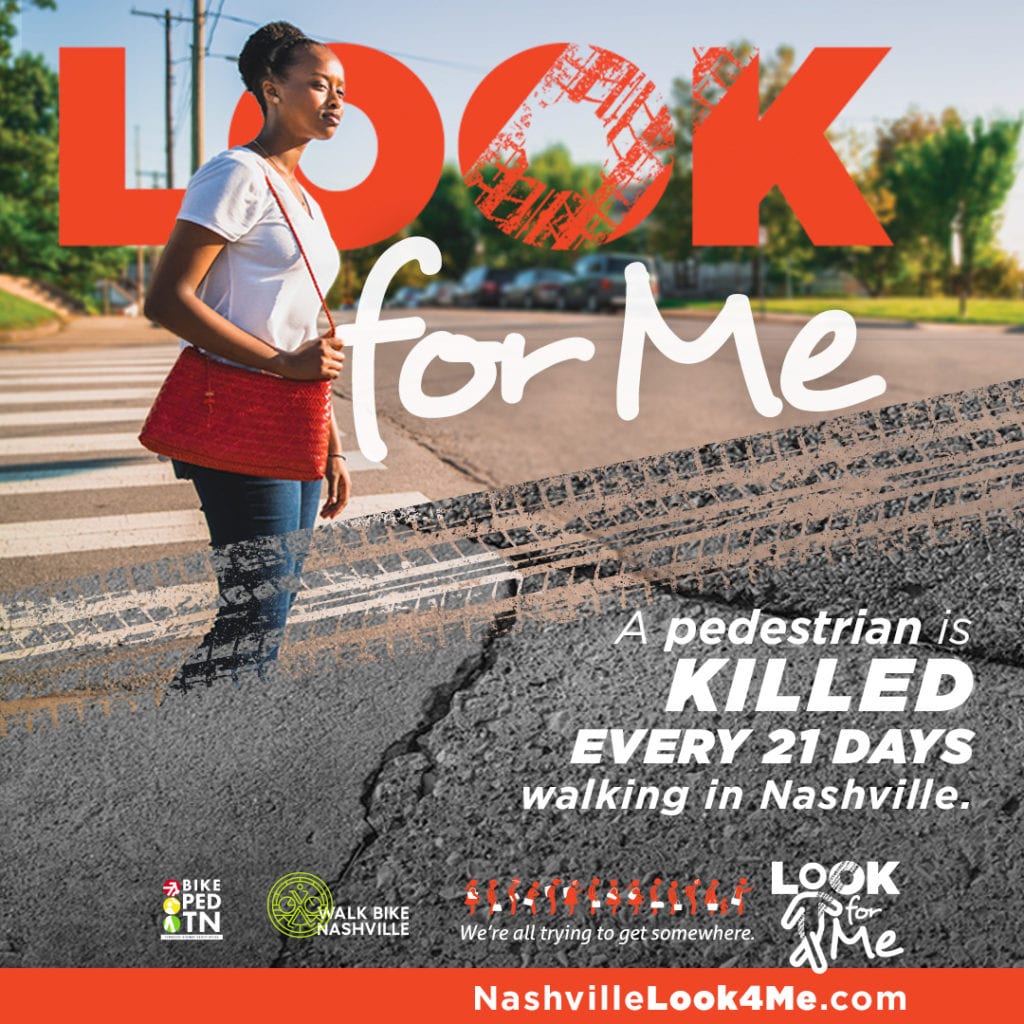
Please take a few minutes to check out the new Look 4 Me campaign with stats about when, where and how pedestrians are struck and often killed in Nashville.
When you live in a city of almost 1 million people where only about 1/3 of streets have a viable sidewalk, typically on only one side of the road, you realize very quickly that it is frankly not safe to walk.
If your pedestrian death rate matches, which it most certainly does in Nashville, you take note that taking a walk could literally mean your life.
Nashville, this is unacceptable and likely illegal.
***
Sidewalks are covered by disabilities act, says prior
White House attorney
June 3, 2003 --
"Laying and maintaining a network of walkways, or sidewalks, for pedestrians to
move about is one of the first and most elementary functions of a municipality,"
wrote U.S. Solicitor General Theodore B Olson, the White House attorney, urging
the Supreme Court last week to deny Sacramento's request that the high court
hear a case on whether "sidewalks" must be made accessible under the Americans
with Disabilities Act.
"Providing and upkeeping a network of walkways for pedestrians to
get around town is a quintessential, not to mention ages old, government
service."
In March, the high court had sought the administration's views on
the issue. Sacramento, joined by over 200 other cities, asked the Court late
last year to hear its appeal in a case it had lost at the Ninth Circuit, in
which disabled individuals had sued the city for failing to install curb ramps
or to maintain them, saying it refused to remove obstacles --benches, sings,
wires protruding from walkways -- that made sidewalks impassable or dangerous,
and that it had refused to even develop the "transition plan" required the law.
The case, which has been in litigation for years, is now close to settlement. The Court has not yet announced
whether it will take the case.
In the brief, the Solicitor General argued that the Ninth Circuit
opinion was "correctly decided," and that it did not conflict with any prior
Supreme Court decisions or opinions in other circuits -- thus, there was no
reason for the high court to hear the case.
Activists who have been watching the case, called Barden v. Sacramento, expressed hope that, based on the
Justice Department's brief, the Court would now refuse the case, keeping the ADA
Title 2 out of the high court for now. A number of advocates praised the
administration for its views on the matter -- that "sidewalks are for everyone."
In the lawsuit and in the appeal to the Supreme Court, Sacramento
and other cities argue that sidewalks are not a "service" of governments as
defined by the ADA.
Not true, said the Justice Dept.; ADA regulations clearly provide
"that newly constructed or altered sidewalks and intersections must include curb
ramps" -- citing 28 C.F.R. 35.151(e). And while this may indeed incur costs for
cities, it said, "in enacting the ADA, Congress made a determination that the
societal benefits of promoting community access to those with disabilities
outweigh the societal costs of complying with the ADA."
Earlier, Lex Frieden, head of the National Council on Disability,
a government agency, had urged Olson to advise the Court that the ADA covered
sidewalks. Frieden added, "Substantial federal funding is available for making
sidewalks accessible to people with disabilities," citing The Transportation
Equity Act for the 21st Century (TEA-21), which authorized the use of Surface
Transportation Program funds for the installation of "pedestrian walkways," and
the modification of public sidewalks to comply with the Americans with
Disabilities Act.
"In addition," said Frieden, "public responsibility for making
sidewalks designed and built with public funds accessible to people with
disabilities did not begin with the ADA or the Rehabilitation Act of 1973.
Technical guidance on making sidewalks accessible has been available since
1961."
Nashville feels like it has designed our roadways for cars and maybe bikes but definitely not for walkers. Like public schools, post offices, roads, courts, and libraries, decent sidewalks are a basic civic right and yet Nashville is coming in woefully deficient with only 37% of our roadways set up with sidewalks.
Other cities are being served with lawsuits for lack of safe infrastructure. The article below is about how San Diego is being sued for lack of safe bike infrastructure despite a big push to bike more in order to curb traffic and pollution.
Sound familiar? We, in Nashville, have had many similar messages these past years to get moving via foot or bike but with an alarming pedestrian death rate to match. This alarming pedestrian death rate is likely closely tied to our lack of sidewalks.
Maybe a lawsuit is in order as there is seemingly no other way to get Nashville to provide.
Nashvillians have certainly been complaining about the lack of safe interconnected walking options for many years and yet our current sidewalk funding will make the job complete in 1000 years. Not a typo: ONE THOUSAND YEARS.
And, what about the many walkers who have died this year walking in Nashville? We have an alarmingly high rate of pedestrians killed on foot. A walker is killed every 21 days here in Nashville. We have speed limits of 30+ in residential neighborhoods. We have little to no enforcement of pedestrian laws. We have horrible lighting conditions and very few sidewalks making Nashville an incredibly deadly environment for walkers. Frankly, we have a city that does not care about walking and it is a shameful and possible illegal situation. There are federal laws that cities must comply with and we do not seem to be getting even close.
Eight months after San Diego paid nearly $5 million to a bicyclist severely injured by damaged sidewalk, the city is facing three more lawsuits from injuries related to bicycling.
One suit blames the city for a bicycle-on-bicycle crash in a Balboa Avenue eastbound bike lane, which is frequently used by cyclists traveling both directions because the city hasn’t built a westbound bike lane on the street.
Another suit blames the city for a bicyclist being launched by damaged concrete in a bike lane in Carmel Valley. And the third suit blames the city for a man getting electrocuted by a bike rack on El Cajon Boulevard in Talmadge.
The lawsuits come as San Diego is encouraging more people to commute by bicycle to fight climate change, reduce traffic congestion and ease parking scarcity. They highlight the city’s lack of adequate infrastructure to accommodate a sharp surge in bicycling commuters, a problem city officials say they are focused on fixing with a regional network of bike lanes that’s being slowly constructed.
Cycling advocates say the network will fix a glaring oversight by city planners, who designed streets in San Diego with specific places for cars and pedestrians but no designated travel lanes for bikes.
San Diego is also grappling with cyclists using sidewalks on streets that lack bike lanes because they feel safer there.
The man who got $4.85 million from the city in March was riding on a tree-damaged Del Cerro sidewalk city officials had been notified about five months before the September 2014 crash.
The crash left Clifford Brown with torn spinal cord ligaments, several lost teeth and brain damage that makes him incapable of functioning independently.
The man injured in the Balboa Avenue bicycle-on-bicycle crash describes similar injuries in his lawsuit, which was filed in September.
The November 2016 crash into another bicyclist allegedly threw Douglas Eggers backward and caused a serious brain injury when his head struck the ground on Balboa near Tecolote Canyon.
He was hospitalized for six weeks and then transferred to a neuro skills facility in Bakersfield where he is still being treated.
Eggers’ lawsuit says the city is at fault because the bike lane it built on Balboa Avenue in 2008 is ripe for head-on collisions. That’s because the street has only one bike lane that is designated for eastbound cyclists, but westbound cyclists also frequently use the lane to avoid the dangers of riding on such a busy street.
His lawsuit says the city should have created a wider bike lane on the north side of Balboa with a divider to accommodate two-way traffic, or the city should have constructed a separate westbound bike lane on the south side of the street.
The suit also notes that the city’s Bicycle Advisory Committee has received complaints about the lack of a westbound bike lane on Balboa.
The injured cyclist in the second lawsuit, Michael Cizaukas, describes somewhat less severe injuries he suffered after being thrown from his bicycle by a two-inch “launching ramp” in a Carmel Valley concrete bike lane buckled by a tree.
Cizaukas says he suffered fractured bones, a separated shoulder, muscle tears, hearing loss and a concussion from the crash, which took place in May 2016 on Carmel Canyon Road near Tarantella Lane.
The suit, filed in August, says the city is obligated to provide cyclists with a hazard-free bike lane and that the city should have known about the raised concrete and fixed it.
In the third lawsuit, also filed in August, Jasper Polintan says he was electrocuted while locking his bike to one of three blue metal bike racks on El Cajon Boulevard near 50th St. in Talmadge.
His suit says he suffered damaged to his upper extremities and other injuries that have reduced his earning capacity.
Polintan says the city failed to provide adequate safeguards and should have either properly installed, repaired or maintained the bike rack.
In preliminary responses to the suits filed with the court, attorneys for the city say city officials were unaware of the problems and that the injured cyclists didn’t take proper precautions.


 Copyright 2018 Nexstar Broadcasting, Inc. All rights reserved. This material may not be published, broadcast, rewritten, or redistributed.
 Copyright 2018 Nexstar Broadcasting, Inc. All rights reserved. This material may not be published, broadcast, rewritten, or redistributed.