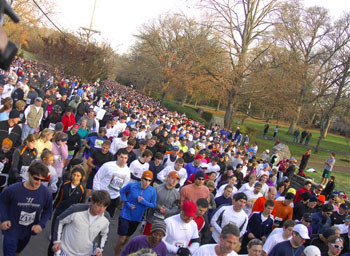
Nashville's annual Turkey Trot, the Boulevard Bolt, raises money for the homeless. The Boulevard Bolt - Nashville is a certified 5-mile course, down and back on Belle Meade Boulevard. Agencies that support the homeless are encouraged to apply for funding.
***
This year, for the first time, safe passage to the race was provided via coning of a single lane on Harding Road. This was highly appreciated as the sidewalk ends at Lynnwood and Harding.
The reason this lane closure seems significant is that Nashville has so few sidewalks. Only 1/3 of our roadways have them. And, we seem at an impasse on what to do about it. They are expensive & complicated to build but cost reductions and simple engineering solutions are not more likely as time goes on. Simple gestures, liking blocking a lane of traffic, is a cheap and fair option while we wait for more permanent infrastructure. Again, much appreciated today!!!
***
As a side note, spied this morning is possibly one of WORST BUS STOPS in Nashville. This is on Harding Rd in front of the Kroger. The bushes do not allow a safe and comfortable place for a PERSON to be. They also do not allow for a clear path to access the bus. This poor guy is literally in the road while he waits.
This bus stop is not ADA compliant. In fact, it is not compliant with the basic civility. It literally has not place for a human to be.
Thankful today for any progress Nashville has made on walkability knowing we have a long way to go...
'Walkability and bikeability always correspond with higher well-being. Why? An easy work commute and pedestrian-friendly streets optimize one of the most important happiness secrets: people. The happiest people socialize several hours per day'. As Nashville leapfrogs ahead to a major transit design, I want to put a plea in for our pedestrians. For at least the last 20 years, Nashvillians (and their mayors) have been talking about building new sidewalks. Talking...not actually building. We are a city/county of 532 sq miles, only a third of which have sidewalks and most on only a single side of that particular street. All this discussion of sidewalks was sparked by an ADA lawsuit waged against Nashville in 1999 that focused on the deficiencies of downtown. Neighborhoods and other civic centers were not held to the same standards as we all can see. So, here we are. 2017. Building 1-2 new miles of sidewalks per year when our need is 1900 miles strong. At this rate, we have just 1000 years at best to go before we have safe sidewalk infrastructure for all. Eighteen years after the ADA lawsuit we are now planning light rails (for the record, I'm all in and LOVE public transportation - to sit and read while on my way? Heaven!). Just please, Nashville, don't forget that we have to actually walk safely and comfortably to it for public transportation to be effective. We need a finite plan for building well designed, ADA compliant sidewalks on ALL major and collector streets ASAP. The time is now. A 10 year plan would be ideal but a 5 year plan even better. And, I know we have issues: this is going to be expensive and our topography is uniquely challenging. But, it is what is is. It is not going to become magically cheaper or easier in the future. If you would like to see more new sidewalks built, please email or call your council person and let them know you would like a FINITE PLAN for sidewalking all MAJOR & COLLECTOR STREETS. These are the big busy corridors and the major cut through streets in neighborhoods. The Tennessean Article - an accounting of new sidewalk production in Nashville Nashville Council Members Nashvillians donate to many civic organizations such as Cheekwood, the Zoo, our wonderful libraries, and to Schermerhorn Symphony. Why not donate to NEW sidewalk production? To Vote for where you need a sidewalk & to Donate to NEW Sidewalks
Hillsboro Pike Literally, no safe place to walk Major Street with bus stops
The happiest cities in America, according to new research
When you live in a city of almost 1 million people where only about 1/3 of streets have a viable sidewalk, typically on only one side of the road, you realize very quickly that it is frankly not safe to walk.
If your pedestrian death rate matches, which it most certainly does in Nashville, you take note that taking a walk could literally mean your life.
Nashville, this is unacceptable and likely illegal.
***
Sidewalks are covered by disabilities act, says prior
White House attorney
June 3, 2003 --
"Laying and maintaining a network of walkways, or sidewalks, for pedestrians to
move about is one of the first and most elementary functions of a municipality,"
wrote U.S. Solicitor General Theodore B Olson, the White House attorney, urging
the Supreme Court last week to deny Sacramento's request that the high court
hear a case on whether "sidewalks" must be made accessible under the Americans
with Disabilities Act.
"Providing and upkeeping a network of walkways for pedestrians to
get around town is a quintessential, not to mention ages old, government
service."
In March, the high court had sought the administration's views on
the issue. Sacramento, joined by over 200 other cities, asked the Court late
last year to hear its appeal in a case it had lost at the Ninth Circuit, in
which disabled individuals had sued the city for failing to install curb ramps
or to maintain them, saying it refused to remove obstacles --benches, sings,
wires protruding from walkways -- that made sidewalks impassable or dangerous,
and that it had refused to even develop the "transition plan" required the law.
The case, which has been in litigation for years, is now close to settlement. The Court has not yet announced
whether it will take the case.
In the brief, the Solicitor General argued that the Ninth Circuit
opinion was "correctly decided," and that it did not conflict with any prior
Supreme Court decisions or opinions in other circuits -- thus, there was no
reason for the high court to hear the case.
Activists who have been watching the case, called Barden v. Sacramento, expressed hope that, based on the
Justice Department's brief, the Court would now refuse the case, keeping the ADA
Title 2 out of the high court for now. A number of advocates praised the
administration for its views on the matter -- that "sidewalks are for everyone."
In the lawsuit and in the appeal to the Supreme Court, Sacramento
and other cities argue that sidewalks are not a "service" of governments as
defined by the ADA.
Not true, said the Justice Dept.; ADA regulations clearly provide
"that newly constructed or altered sidewalks and intersections must include curb
ramps" -- citing 28 C.F.R. 35.151(e). And while this may indeed incur costs for
cities, it said, "in enacting the ADA, Congress made a determination that the
societal benefits of promoting community access to those with disabilities
outweigh the societal costs of complying with the ADA."
Earlier, Lex Frieden, head of the National Council on Disability,
a government agency, had urged Olson to advise the Court that the ADA covered
sidewalks. Frieden added, "Substantial federal funding is available for making
sidewalks accessible to people with disabilities," citing The Transportation
Equity Act for the 21st Century (TEA-21), which authorized the use of Surface
Transportation Program funds for the installation of "pedestrian walkways," and
the modification of public sidewalks to comply with the Americans with
Disabilities Act.
"In addition," said Frieden, "public responsibility for making
sidewalks designed and built with public funds accessible to people with
disabilities did not begin with the ADA or the Rehabilitation Act of 1973.
Technical guidance on making sidewalks accessible has been available since
1961."
Nashville feels like it has designed our roadways for cars and maybe bikes but definitely not for walkers. Like public schools, post offices, roads, courts, and libraries, decent sidewalks are a basic civic right and yet Nashville is coming in woefully deficient with only 37% of our roadways set up with sidewalks.
Other cities are being served with lawsuits for lack of safe infrastructure. The article below is about how San Diego is being sued for lack of safe bike infrastructure despite a big push to bike more in order to curb traffic and pollution.
Sound familiar? We, in Nashville, have had many similar messages these past years to get moving via foot or bike but with an alarming pedestrian death rate to match. This alarming pedestrian death rate is likely closely tied to our lack of sidewalks.
Maybe a lawsuit is in order as there is seemingly no other way to get Nashville to provide.
Nashvillians have certainly been complaining about the lack of safe interconnected walking options for many years and yet our current sidewalk funding will make the job complete in 1000 years. Not a typo: ONE THOUSAND YEARS.
And, what about the many walkers who have died this year walking in Nashville? We have an alarmingly high rate of pedestrians killed on foot. A walker is killed every 21 days here in Nashville. We have speed limits of 30+ in residential neighborhoods. We have little to no enforcement of pedestrian laws. We have horrible lighting conditions and very few sidewalks making Nashville an incredibly deadly environment for walkers. Frankly, we have a city that does not care about walking and it is a shameful and possible illegal situation. There are federal laws that cities must comply with and we do not seem to be getting even close.
Eight months after San Diego paid nearly $5 million to a bicyclist severely injured by damaged sidewalk, the city is facing three more lawsuits from injuries related to bicycling.
One suit blames the city for a bicycle-on-bicycle crash in a Balboa Avenue eastbound bike lane, which is frequently used by cyclists traveling both directions because the city hasn’t built a westbound bike lane on the street.
Another suit blames the city for a bicyclist being launched by damaged concrete in a bike lane in Carmel Valley. And the third suit blames the city for a man getting electrocuted by a bike rack on El Cajon Boulevard in Talmadge.
The lawsuits come as San Diego is encouraging more people to commute by bicycle to fight climate change, reduce traffic congestion and ease parking scarcity. They highlight the city’s lack of adequate infrastructure to accommodate a sharp surge in bicycling commuters, a problem city officials say they are focused on fixing with a regional network of bike lanes that’s being slowly constructed.
Cycling advocates say the network will fix a glaring oversight by city planners, who designed streets in San Diego with specific places for cars and pedestrians but no designated travel lanes for bikes.
San Diego is also grappling with cyclists using sidewalks on streets that lack bike lanes because they feel safer there.
The man who got $4.85 million from the city in March was riding on a tree-damaged Del Cerro sidewalk city officials had been notified about five months before the September 2014 crash.
The crash left Clifford Brown with torn spinal cord ligaments, several lost teeth and brain damage that makes him incapable of functioning independently.
The man injured in the Balboa Avenue bicycle-on-bicycle crash describes similar injuries in his lawsuit, which was filed in September.
The November 2016 crash into another bicyclist allegedly threw Douglas Eggers backward and caused a serious brain injury when his head struck the ground on Balboa near Tecolote Canyon.
He was hospitalized for six weeks and then transferred to a neuro skills facility in Bakersfield where he is still being treated.
Eggers’ lawsuit says the city is at fault because the bike lane it built on Balboa Avenue in 2008 is ripe for head-on collisions. That’s because the street has only one bike lane that is designated for eastbound cyclists, but westbound cyclists also frequently use the lane to avoid the dangers of riding on such a busy street.
His lawsuit says the city should have created a wider bike lane on the north side of Balboa with a divider to accommodate two-way traffic, or the city should have constructed a separate westbound bike lane on the south side of the street.
The suit also notes that the city’s Bicycle Advisory Committee has received complaints about the lack of a westbound bike lane on Balboa.
The injured cyclist in the second lawsuit, Michael Cizaukas, describes somewhat less severe injuries he suffered after being thrown from his bicycle by a two-inch “launching ramp” in a Carmel Valley concrete bike lane buckled by a tree.
Cizaukas says he suffered fractured bones, a separated shoulder, muscle tears, hearing loss and a concussion from the crash, which took place in May 2016 on Carmel Canyon Road near Tarantella Lane.
The suit, filed in August, says the city is obligated to provide cyclists with a hazard-free bike lane and that the city should have known about the raised concrete and fixed it.
In the third lawsuit, also filed in August, Jasper Polintan says he was electrocuted while locking his bike to one of three blue metal bike racks on El Cajon Boulevard near 50th St. in Talmadge.
His suit says he suffered damaged to his upper extremities and other injuries that have reduced his earning capacity.
Polintan says the city failed to provide adequate safeguards and should have either properly installed, repaired or maintained the bike rack.
In preliminary responses to the suits filed with the court, attorneys for the city say city officials were unaware of the problems and that the injured cyclists didn’t take proper precautions.
Our current Mayor started by stating her commitment to building sidewalks but, with our current rate of progress, it is projected to be 1000 more years before Nashville is fully sidewalked. That is far from a true commitment to walkability.
To me, walking is a basic human right. In my city, where I pay taxes, I should be able to walk safely from point A to B. I should be able to allow my children to walk safely, too. But, in Nashville, you literally cannot walk in a safe and comfortable fashion. We only have sidewalks on 37% of our streets.
A reminder to all Nashvillans, our city was sued for American with Disabilities Act Non-Compliance and settled around the year 1999. As a result, the Strategic Sidewalk Plan came out in 2002 with a master plan. It has, sadly, never been properly funded.
60 Million in funding is just not going to cut it. I give Nashville and Mayor Barry an F for walkability and our statistic support it.
Maybe another lawsuit is in order?
This is a bus stop near a busy shopping district in Nashville which is literally unwalkable.
New sidewalk construction by Metro Nashville Public Works
January 2016 - October 2017: 3.5 miles (1.9 miles/year average) with 1900 miles to go....
2015: 1.4 miles
2014: 2.0
2013: 1.9
2012: 0.8
2011: 1.7
Source: Metro Nashville Public Works, Tennessean analysis
Percent of streets with sidewalks
Minneapolis 92%
Seattle 71%
Austin 50%
Nashville 37%
Source: Metro Nashville Public Works, WalkNBike Draft Plan (2016)
L.A. agrees to spend $1.3 billion to fix sidewalks in ADA case By Emily Alpert Reyes
Apr 01, 2015
Los Angeles is pledging to spend more than $1.3 billion over the next three decades to fix its massive backlog of broken sidewalks and make other improvements to help those with disabilities navigate the city as part of a tentative deal being described as a landmark legal settlement.
The proposed agreement would resolve a lawsuit filed by attorneys for the disabled, who argued that crumbling, impassable sidewalks and other barriers prevented people in wheelchairs or others with mobility impairments from accessing public pathways in violation of the Americans With Disabilities Act.
The final terms must still be approved by a federal judge, but attorneys described it as the biggest agreement of its kind in U.S. history.
City leaders said the proposed deal marks the beginning of a sorely needed effort to eliminate one of Los Angeles' most intractable neighborhood nuisances: the ugly and treacherous obstacle courses created by miles of buckling walkways.
City officials and advocates for the disabled praised the agreement at a news conference. Communities Actively Living Independent and Free Executive Director Lillibeth Navarro, whose group was among those suing the city, called it "a major win" for people with disabilities who had suffered frustration and injuries trying to move around the city. Councilman Paul Krekorian said it was a historic victory not only for people with disabilities, but also for the elderly and "anyone who is ever a pedestrian."
Under the terms of the proposed settlement agreed to by the City Council and announced Wednesday, the city must spend $31 million annually on sidewalk and other improvements beginning in the next budget year. That amount would gradually increase to $63 million in future years to adjust for rising costs.
The settlement doesn't identify any new source of funding. But City Administrative Officer Miguel Santana noted that the deal does not limit the type of funding Los Angeles can use to pay for the repairs, meaning the city could seek various grants for the work.
It's unclear whether the promised money will completely eliminate the backlog. The Bureau of Street Services has estimated that about 40% of city sidewalks need repairs. At one point, the price tag was estimated at $1.5 billion. But Santana said there is no reliable estimate for the full cost.
UCLA urban planning professor Donald Shoup said: "It's sad to think that the only thing that has caused any movement in 40 years is a lawsuit.… But of course I'm glad they're doing it."
Even with the promised spending, he added, "It would take decades to fix our sidewalks."
Mayor Eric Garcetti said he believed the spending would be enough to stay ahead of any ongoing deterioration of aging city sidewalks. Attorney Guy Wallace, one of several lawyers representing plaintiffs in the case, said the record agreement was larger than a major, $1.1-billion settlement reached several years ago with Caltrans, the state transportation agency.
The Los Angeles suit alleged that lack of public access for Angelenos in wheelchairs "relegates them to second-class citizen status" and prevents them from being independent. Wallace said at a news conference that more than 200,000 Angelenos with mobility disabilities had struggled to navigate "dysfunctional and inaccessible" sidewalks. Tim Fox, a Denver-based attorney who is on the national board of the American Civil Liberties Union, said the settlement represented an unprecedented move by a city to broadly improve access to its sidewalks for the disabled.
The city plans to start by repairing sidewalks around parks and other city facilities, but will also fix walkways in other areas that are heavily trafficked, close to hospitals or workplaces, or requested by people with mobility challenges, including those alongside homes, Santana said. The only sidewalks that would be categorically left out are those next to buildings run by other government entities, including the Los Angeles Unified School District or federal or state agencies.
Funding to fix sidewalks has been haphazard over the years, and the city abandoned any systematic sidewalk repair program after the recession hit seven years ago. As the economy has improved, the city has revived its program and budgeted $27 million for repairs this year.
So far, Los Angeles has focused its efforts on walkways next to parks and other city facilities. Some council members have also devoted money from their discretionary funds to fix sidewalks in their districts. But the problem remains glaringly obvious in many areas and has cost the city more than $6 million in trip-and-fall payouts in less than four years, according to the city attorney's office.
Kathleen Law, 73, a Hollywood resident whom the city paid $50,000 after she tripped on a jagged sidewalk and shattered her right knee cap in 2008, said the plan was overdue.
"It's absolutely a must," said Law, adding that she still suffers pain from her injury and has had to drastically curtail her preferred form of exercise — walking. "There are some streets I just can't walk on because it's too risky."
The deterioration of city sidewalks is tied to a historic tug of war over who is responsible for fixing them. Los Angeles once held property owners responsible for fixing the adjacent sidewalks, conforming with California law. But decades ago, with federal funding in hand, the city took on responsibility for fixing sidewalks damaged by city trees.
That federal money quickly dried up and Los Angeles voters proved unwilling to pony up more tax money to continue repairs. In 1998, a move to authorize $769 million in bonds for sidewalk work was rejected. Last year, lawmakers abandoned a plan to ask voters to hike the sales tax to pay for street and sidewalk repairs.
Shoup argued that the city should pursue additional measures, including requiring owners to fix broken sidewalks next to their property when they sell.
The proposed settlement is silent on who is legally responsible for sidewalks next to private property — leaving the door open for that kind of program, Shoup suggests. Santana said city lawmakers still have to grapple with those types of issues.
Under the terms announced Wednesday, the city can reduce its annual spending slightly — to $25 million — but it must make up for it within the next three years.
With the City Council's approval of the settlement terms, city lawyers can present a final agreement to the court.
In addition to the $1.3 billion pledged for repairs, the city will pay $15 million in attorneys fees and costs. Wallace said the city is also creating a position to monitor the work and will draft reports on its progress twice yearly.
A buckled sidewalk at 4th and Main streets in downtown L.A. (Gary Friedman / Los Angeles Times)
This is a must read if you live in Nashville and care about pedestrian safety and sidewalk production. An accounting of sidewalks production in Nashville, the good, the bad and the ugly...
Nashville has allocated $60 million for sidewalks. What has the city accomplished?
One of Mayor Megan Barry’s first major announcements after taking office in September 2015 was to devote more funding to sidewalks, which Nashville sorely lacks.
She allocated $30 million in each of her first two years in office, more than her predecessors. Her ambitious public transit plan depends on people walking to bus and light rail stations.
So what has the city done with the money? It built 3.5 miles of new sidewalk, in addition to making repairs. That’s slightly more than the average built during the previous five years, but less than half the pace set out by the city’s recent pedestrian and bikeways plan. At that clip, it would take more than a millennium (to be clear, that is 1000 years!!!!!!!!!!!!!!!) to line all of Nashville’s streets.
City officials say they've spent the last two years refining their sidewalk plans and designing difficult, time-consuming projects. Besides the completed miles, they have an additional 2.4 miles under construction and 4.9 miles scheduled for construction. Also, real estate developers have built more than 20 miles since January 2016. But critics contend that Nashville’s Public Works Department spends too much on high-priced consultants, over-complicates some designs and is understaffed for the sidewalk surge.
“It’s pretty frustrating how slow it’s going,” said Nora Kern, executive director of Walk Bike Nashville, a pedestrian advocacy group. “I’m sure I can speak for a lot of people when I say that.”
While many residents look at sidewalks as quality-of-life amenities, they’re also key to safety, experts say. Pedestrian deaths in Nashville have reached a record high this year, with 19 people killed so far – up from 16 in all of 2016. As new residents move here expecting "walkability" and long-time residents have grown tired of waiting for sidewalks, Barry and others have emphasized new construction. Barry, through a spokesman, declined to be interviewed.
Nashville lags behind comparable cities. Nearly two-thirds of the city’s streets have no sidewalks, according to a Metro consultant’s plan released this year. Austin, not a shining example, has half of all streets covered. Seattle has 71 percent.
With the scope of the problem laid bare, Metro officials have spent much of the past two years developing a system to prioritize which sidewalks to build first. Some projects, officials also say, are taking longer to design because they’re more complicated than those built during previous administrations.
“There’s perception that sidewalks are pretty easy to do, and sometimes they are, but sometimes they’re like mini road projects,” said Michael Briggs, the Metro Nashville manager of multimodal transportation planning. “The real reason we’ve slowed down is we’re getting to a lot of the harder projects.”
Metro tries to strike a balance between new construction and repairs
Earlier this year Metro finished its WalkNBike plan, which identified 91 miles of high-priority stretches of roadway. The priority sidewalk segments are along transit routes, dangerous roadways, near schools, and places with glaring sidewalk gaps. The total bill for those projects was estimated at $550 million. In total, Metro has 1,900 miles of streets without sidewalks.
We’re in the process of trying to turn the ship around,” Briggs said.
He pointed to one project being planned in West Nashville, at Davidson Road between H.G. Hill Middle School and Hillwood High School. Engineers had to design curbs, gutters, and maneuver the sidewalk path around major utility poles. In the past, Briggs said, Metro was more likely to tackle simple residential streets, or to build stripped-down walkways.
“They weren’t good quality sidewalks,” said Metro Councilwoman Angie Henderson, a longtime sidewalk proponent who represents Forest Hills and Oak Hill. “They were narrow, they were on the street. Those were frankly taking the easy path.”
Henderson was the lead sponsor of a bill that passed this year requiring more residential developers to add sidewalks when they build new single-family homes and duplexes, or to pay into a Metro sidewalk fund. It took effect in July.
While new sidewalk construction has taken a back seat to planning, Metro has repaired about 40 miles of damaged sidewalks since January 2016, outpacing the average for previous years. It spent roughly $10 million on repairs during that time, and $22 million on new construction.
That ratio of repairs to new construction is a departure from previous years, officials said, when it was closer to half-and-half. Officials are prioritizing new construction, but have just been slow to spend the money. More than $21 million is unencumbered from the $30 million fiscal 2017 budget.
As the backlog of projects accumulates, some have suggested that Metro could look for less expensive, less elaborate designs. Other cities rely on more “green” infrastructure -- using grass and other permeable surfaces to absorb runoff, instead of concrete. Metro officials say they are considering more environmentally-friendly, less expensive alternatives.
“It’s striking the balance between the quality of infrastructure and the speed of infrastructure,” said Henderson.
Are contractors boosting sidewalk costs?
Another drain on time and sidewalk resources, critics say, is Public Works’ reliance on contractors. After the 2008 financial crisis, Metro slashed its engineering staff when the capital improvement budget dwindled. Metro officials say they haven’t staffed up to build more sidewalks because of unpredictable funding.The sidewalk budget fluctuated between $8 million and $25 million, for instance, in the three years before Barry took office.
Instead, they’ve relied on an outside firm to manage the sidewalk program, with one full-time Public Works employee managing the contractors (others in Metro handle sidewalk projects part-time). Nashville-based Civic Engineering and Information Technologies signed a $10 million, five-year contract for sidewalk and bikeways project management in 2013.
Civic charges $160 per hour for a program manager, while Nashville’s on-staff sidewalks manager makes roughly $44 an hour, including health and retirement benefits
Metro officials say outsourcing allows them to ramp up the program quickly, and to scale back, depending on the funding. Also, if a given project is especially difficult, Briggs said, “it’s easier to shift contractors around from job to job if there are challenges.”
But some observers question if the city is getting the most for its money. Besides the complex project designs, contractors handle relatively low-skilled tasks: they attend community outreach meetings, interact with council members, and work on the project budgets.
“There’s a lot of non-engineering stuff that happens in the management of these contracts,” said Adams Carroll, a former Nashville planner who now directs Pittsburgh's bike share program.
He surveyed four other cities to see how much they budgeted per linear foot of new sidewalks. The average from Memphis, Louisville, Denver and Austin was $135, compared to Nashville’s estimate of more than $1,000 per foot. Metro officials point out their figure includes stormwater infrastructure costs and the cost for acquiring rights-of-way from adjacent property owners. It’s not clear whether the other cities factored in those costs.
Carroll said the comparison may not be perfect, but it points to another one of Nashville’s challenges: The city lumps a lot of expenses into the sidewalk budget besides sidewalk construction — from gutters to sewers, trees, and layers of consultants.
Metro Councilman John Cooper said he believes that Nashville’s sidewalk construction costs are roughly four times that of comparable cities.
“We haven't really come to terms with why,” said Cooper, who also questioned the use of contractors. “There is very little formal accountability.”
A representative from Civic did not respond to a request for comment.
How to measure progress?
The Public Works Department and the Planning Department are creating an online sidewalk progress tracker, so the public can see what is being built, and when. It will match the WalkNBike priority scores with cost estimates, to determine which segments will be built in the next few years. Expected to be completed months ago, the tracker has hit some technical snags, but officials are still hoping to complete it by the end of the year.
Councilwoman Henderson said she has been waiting for the tracker to evaluate if the city is building new sidewalks at a reasonable pace. Up to this point, Metro has not set a goal for sidewalk construction each year.
“We have to have measurable goals,” she said. “If we don’t have measurable short-term goals, how do we measure our long-term progress?”
Kern, the sidewalk advocate, says the tracker will satisfy a more fundamental need: “Most people have no idea what’s coming or how the money is being spent.”
New sidewalk construction by Metro Nashville Public Works
January 2016 - October 2017: 3.5 miles (1.9 miles/year average)
2015: 1.4 miles
2014: 2.0
2013: 1.9
2012: 0.8
2011: 1.7
Source: Metro Nashville Public Works, Tennessean analysis
Percent of streets with sidewalks
Minneapolis 92%
Seattle 71%
Austin 50%
Nashville 37%
Source: Metro Nashville Public Works, WalkNBike Draft Plan (2016)