More and more Americans are leaving driving behind. Nashville, this is yet another wake up call that we need to be putting the building of pedestrian and public transportation infrastructure first on our list of to-dos.
This concrete pad is a bus stop. But, if you look up and down the road, the following pictures are what you see. How, do you propose, you get to this bus stop??? And, this is in the Urban Service District in the very popular Green Hills/Hillsboro Village area.
We need to stop building roads like this with a bus stop that is of questionable use. This piece, on NPR this morning, is also strong support that citizens need better walkability and cities need to prioritize it in order to continue to attracts the young and keep the older.
Like Millennials, More Older Americans Steering Away From Driving
A growing number of Americans are driving less and getting rid of their cars.
The trend that used to be more prominent among younger adults — millennials — is now gaining traction in middle-aged adults as well, to the point where fewer of them are even bothering to get or renew their driver's licenses.
"Honestly, at this point, it just doesn't really seem worth it," says 25-year-old Peter Rebecca, who doesn't own a car or have a driver's license. "I mean, I live in Chicago, there's really good access to, you know, public transits for pretty cheap."
The student at Harold Washington College downtown lives just a couple of blocks from a rail stop on the Northwest side. In the warmer months, Rebecca says he uses a bike.
"I've got a bunch of grocery stores in walking distance and even then I can use the bus if I have to get further," he says.
Rebecca is hardly alone, especially among young adults in urban areas.
"Over the past several decades, particularly for the youngest age groups, there's been a pretty large decrease in the number of people who have been getting driver's licenses," says Brandon Schoettle, a researcher at the University of Michigan.
He led a new study published by University of Michigan's Transportation Research Institute that studied the proportion of people with driver's licenses over the years.
According to the study, only 69 percent of 19-year-olds have a driver's license in 2014, compared to almost 90 percent in 1983. The percentage of 20-somethings with driver's licenses has also fallen by 13 percent over the last three decades, and fewer Americans in their 30s and 40s now have driver's licenses.
Fewer Drivers Among Younger Generations
Proportion of licensed drivers in 1983 and 2014, by age
16 years old
17 years old
18 years old
19 years old
20-24
25-29
30-34
35-39
40-44
45-49
50-54
55-59
60-64
65-69
70 and older
Susan Schell might soon be one of them. The manager of a Starbucks on Chicago's northwest side says her driver's license is up for renewal this month, yet she doesn't own a car.
"I used to. I got rid of it just because it's too much of a pain in the butt to have in Chicago and we kept getting tickets and I just didn't want to deal with it," Schell says.
In addition to living in a city that is relentless in doling out parking tickets, Schell says there's the cost of insurance, gas, and maintenance on top of the cost of the car itself. Her husband recently let his driver's license expire because they take public transit to work, and they have other options for shopping.
"We use, services like such as Instacart a lot," she says. "...If we've done like a big trip at Target or something, we just call an Uber. There's so many options when you live in a city."
Schoettle says now this trend is not just limited to teenagers and those in their 20s.
"For some of the oldest age groups, which had seen relatively large increases in licensing over the past few decades, finally seemed to have peaked and have started to show some small decreases in licensing," he says. "And so for the first time in the series of reports that we've done, we've kind of seen a decrease in the percentage of people with a license across all age groups."
Forty-eight-year-old Raul Chavez hasn't renewed his driver's license since it expired more than a year ago — and he keeps his car parked.
"It's quite a bit expensive because you have to have insurance," he says. "The latest two years I used public transportation and I really enjoy it because it's cheap and it's reliable everywhere you're gonna go."
Schoettle says that's one of the main reasons more Americans of all ages are going without driver's licenses.
"There's been a shift publicly for people to move to things like public transportation that just wasn't there back in the 80s and 90s, partly because there's sometimes better public transportation in certain areas than there was few decades ago and a little more concern about the environment," he says.
Schoettle says he'll be watching to see if cheaper gas might reverse the trend.
Do you sense that there is a sensitive and delicate balance currently between developers and Nashville? Is the climate here so fragile that even one extra requirement would sour all deals going forward?
Look familiar?
First look: $100M+ project starts behind Mall at Green Hills
207-room Hilton and a 116-room Marriott Residence Inn. Notably, the project also includes about 30,000 square feet of top-floor office space, as well as retail space at street level.
I think it is time to very seriously consider that Nashville is making a big mistake in regards to sidewalks. When a developer creates density (taking a single home and building 2+ homes on the same site) they are to factor in the building of walkways in front of the property. These pieces would eventually be knitted together to form a cohesive sidewalk network. Now, this makes sense. You add density (more people, more cars) but you gift back to the neighborhood enhanced walkability. But, instead, developers can pay a fee (the In-Lieu Fee) at a fraction of the cost of building the sidewalk ($92 per linear foot or $250 per linear foot AND build the sidewalk...now, you see why developers pay the fee!). In essence, Nashville is subsidizing the non-building of sidewalks.
Some have argued that these pieces would be 'sidewalks to nowhere' but what we currently have going on is just NO sidewalks. In October of 2014, an increase in the In-Lieu fee from $15 per linear foot to $96 went into effect - a step in the right direction. Even still, the In-Lieu fee, which was started in 2001, has accumulated just under 1 million dollars - enough to build 1/2 mile of sidewalk. I ask you, is this a failed policy?
Nashville is red hot in regards to re-development. Whole blocks seem to disappear overnight to be quickly replaced by larger or more numerous homes and mixed use developments. And, Nashville has been really kind to this increase in size and density - developers know that it is pretty easy here. There has been a careful considering of keeping the costs and restrictions minimal in order not to curb expediency. So careful has this consideration been in favor of development that we are now facing the prospect of, once again, building a city that has little to no walkability. I argue that this is a HUGE mistake. NOW is the time to build sidewalks. It will NOT get easier or cheaper in the future.
The construction site at the split of West End and Broadway has been vacant since 2007. It has be named Palmer Lake after the developer that originally took on the project. The Lake currently has black fences around the perimeter of the site which TURBO in conjunction with West End Business Association has identified as an ideal space for public art! Come to our monthly meeting tomorrow and discuss what could be done.
Nashville Needs Sidewalks
Head over to the Shade Parade Blog and learn about all the great things you can find on foot walking around Nashville. Join the #NashvilleNeedsSidewalks campaign on Instagram. Use #dontblockmywalk for sidewalk areas that are obstructed. Be sure to follow @turbonashville. Want a Nashville Needs Sidewalk water-proof sign? Write to: thesidewalkfoundation@gmail.com
Little Library at Elmington Park has been restored and restocked!
***
If you haven't visited Elmington Park at the corner of West End and Bowling - consider a trip soon. This park is part of the 440 Greenway proposal, houses West End Middle School and has a lively weekend scene. It is also the origin of our Sidewalk Project #1...to complete the sidewalk on Bowling a very beautiful way.
Frankly, it is just easier to head (read drive) to the gym to get my work-out than to brave the dark narrow fast-paced streets once it is dark in Nashville. The number of pedestrian deaths in our town is clear cut evidence that no one is over-reacting to the real dangers of being a pedestrian in our city of almost a million and growing.
The image above is a strong argument for the pent up demand for sidewalks in Nashville. On an unseasonably warm evening in Nashville (in February!), there is no reason that so many would pack themselves into a crowded gym.
***
***
Nashville is currently 'crane city' meaning we are building very fast. The New York Times has, over and over again, called us an 'it' city. But, I am hearing discussions of a cooling in our rapid development, particularly in apartments, due to our lack of infrastructure (read sidewalks) to support this kind life.
***
Want to 'vote' by dropping a pin where you see a strong need for a sidewalk? Want well designed sidewalks in Nashville? Consider a donation to thesidewalkfoundation.org (coming very soon).
Want developers to put in their piece of the sidewalk grid? Ask your councilperson to get rid of the Sidewalk In-Lieu fee that allows developers to pay a drastically reduced fee rather than put in their bit.
Want a Nashville Needs Sidewalk water-proof sign? Write to: thesidewalkfoundation@gmail.com
I recently had a meeting at the Lentz Public Health Center (https://www.nashville.gov/Health-Department/Clinic-Locations/Lentz-Public-Health-Center.aspx ) here in Nashville. I was thrilled to see an indoor track around the cubicles and work spaces flooded with natural light. They also have an separate outdoor walking area that encircles the parking lot but does not make people dodge cars (I have a lot of experience with this as I work at One Hundred Oaks - I can tell you, it is NOT relaxing or meditative to have to keep a keen eye for cars backing out). In addition, employees are allowed 30 minutes, as part of their work day, to get up from their desk and exercise!
Imagine!
Indoor track around the work spaces
Attention to natural light
Similarly, there are other Public Health Depts that are working hard to build physical activity into the lives of the citizens they care for. The article below from Buncombe Co (Thanks Mike!) highlights similar issues to what we have here in Nashville.
The fact is that very few Nashvillians get the recommended 30 minutes of physical activity a day. Between sedentary jobs and commuting via private car, the average active minutes obtained here in TN is very, very, embarrassingly low: cloaking in somewhere between 3-6 minutes per day for most.
Cities need to do a better job of building infrastructure (read sidewalks) so that all citizens can get out easily and safely on foot.
***
City and county leverage resources to encourage active transportation
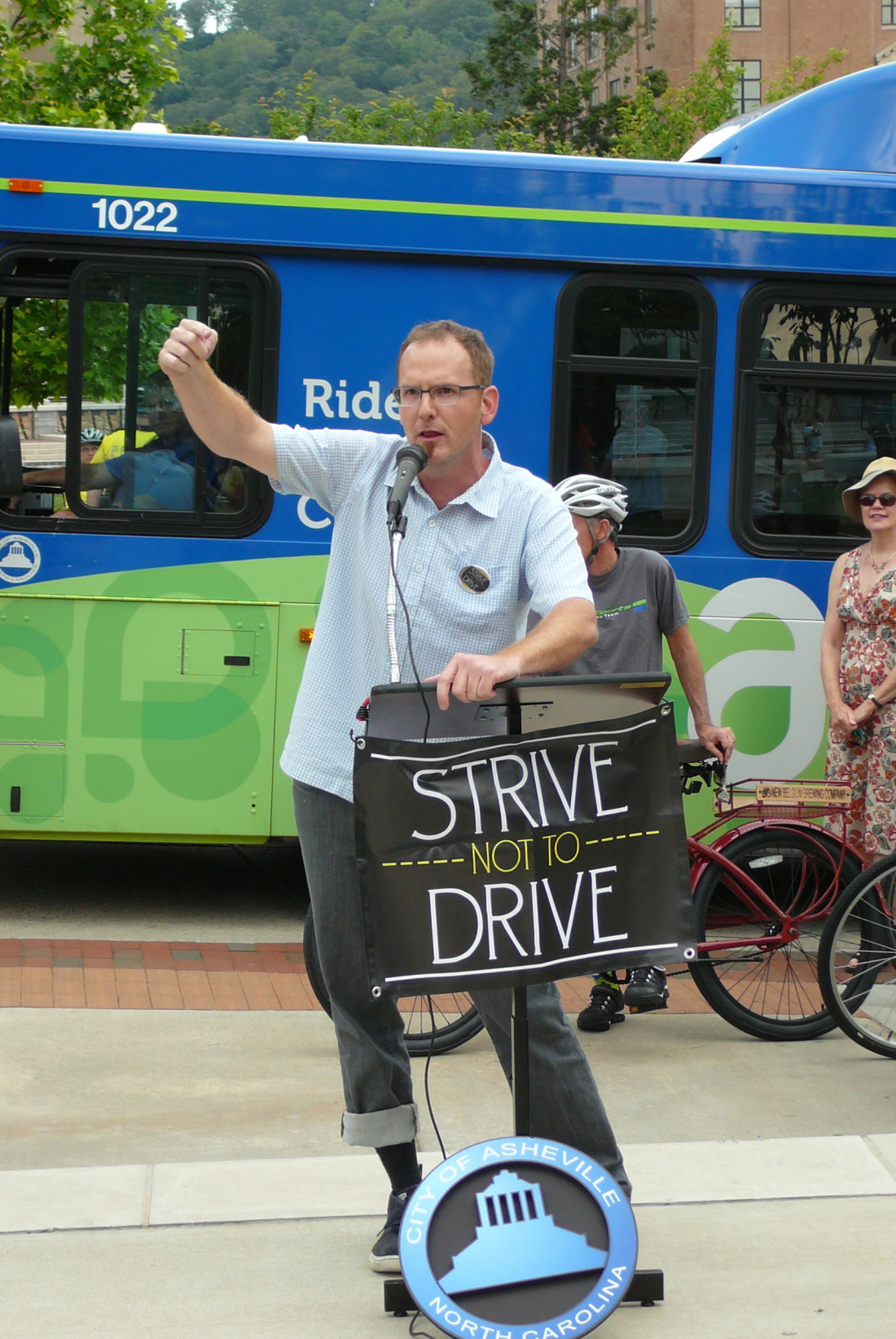
GET A MOVE ON: Each spring, Asheville on Bikes executive director Mike Sule and other advocates help organize a Strive Not to Drive campaign to encourage multimodal and active transit. Photo by Jake Frankel
In the early days of Buncombe County’s history, no one worried much about whether county residents were physically active. Most people engaged in some form of physical labor in the course of their daily lives, and most thought little of walking miles to accomplish everyday activities like shopping, running errands, going to school and attending church.
Back then, Buncombe County focused its fledgling public health efforts on projects that included a vaccination program, inspection of water sources and establishing a clinic for the treatment of venereal disease. During the influenza epidemic of 1919, the Health Department set up temporary hospitals to accommodate the thousands of patients the area’s few private hospitals couldn’t handle.
But these days, the Health Department’s role has grown far beyond the prevention and treatment of disease. Now charged with providing opportunities for residents to make healthy choices within a healthy environment, Public Health Director Jan Shepard says her department is looking for ways to help the community shift the balance toward positive health outcomes.
Overcoming sedentary habits and encouraging physical activity as a normal part of everyday life are among the healthy choices Shepard wants to encourage. To accomplish that goal and many others, her department is embracing an innovative “collective impact” model
While the Department of Health continues to serve as Buncombe County’s public provider of a wide variety of health-related services, it is increasingly focused on collaborating with other governmental entities, funding sources and community partners to achieve its mission, Shepard says.
“Part of what we try to do is to infuse public health into planning committee meetings or into a Parks and Recreation meeting, so that we are bringing awareness of the health consequences of the policy decisions that are made,” Shepard explains.
“Our role is to remain that anchor institution that doesn’t go away in recessions, that’s here under all circumstances, and to provide guidance, support and communication,” adds Lisa Eby, human resources director for the Buncombe County Health and Human Services department.
“Buncombe has made huge strides in placing public health professionals where they can have a greater impact,” continues Shepard, outlining programs to embed staff previously employed by the Health Department into community resource agencies to provide better reach and coordination of services. The changes are not intended to save money: County funding for the positions has stayed the same or increased, Eby clarifies. Starting young
School health program manager Alice Elio is one of the staffers who moved from the Health Department to the Mountain Area Health Education Center as part of the shift. She supervises some of the 24 school nurses working in the county and city schools under the auspices of MAHEC.
Elio says helping students incorporate healthy choices like walking and biking into daily life is one of the most effective approaches for promoting health and well-being among our community’s children. “Research shows a correlation between increased physical activity levels where school and community design and policy support walking, biking and transit use,” she says.
Terri March, a health improvement specialist who worked at the Buncombe County Health Department for 14 years before transferring to MAHEC 18 months ago, agrees that a focus on active transportation is a key strategy for promoting community health. March serves on the city’s Multimodal Transportation Commission and its Bicycle and Pedestrian Task Force, and she also helps facilitate the Safe Routes to School initiative, which encourages kids to walk and bike to school. Shaping the environment
But educating students and families about the benefits of walking and biking won’t convince residents to embrace active transportation if they are stymied by missing sidewalks, unsafe crossings or other obstacles (sounds like Nashville!).
“We look at connectivity and opportunities for all segments of the population to move across the city,” says Mariate Echeverry, transportation planning manager for the city. “Our job is to think of the system as a whole and try to enhance connection opportunities where there are gaps.”
Yuri Koslen, transit project coordinator, agrees: “The goal is to accommodate everyone: kids, older people, those with physical disabilities. A person’s willingness to make a trip using active forms of transportation is determined by the weakest link. The rest may be very safe. It’s those links that make it difficult.”
Eby mentions one example of how interagency cooperation bridged a gap and enabled a large group of residents to access opportunities for healthy outdoor recreation. “When Carrier Park was first built, we realized that the residents of the close-by Pisgah View apartments had no safe way to walk to the park,” Eby recalls. “(City transportation director) Ken Putnam sits on the county’s Health and Human Services Board, where he heard about the problem. He got a crosswalk installed to provide safe access to the park.”
To address these kinds of challenges, the city’s Transportation Department is engaged in a number of initiatives to increase both the number of active transportation options and the connections between them.
The city’s pedestrian plan, last updated in 2004, has guided city investments and development policies to create needed linkages for safe pedestrian travel.
The city’s Neighborhood Sidewalk Plan was approved on Oct. 13 as a tool for evaluating new sidewalk construction needs. The plan provides a transparent method for ranking about 90 miles of potential sidewalk projects in order of priority. However, the city’s current annual budget for new sidewalk projects is $350,000, which will build about 1,000 feet of new sidewalk; as a result, residents shouldn’t look for a big increase in the number of sidewalks in the city anytime soon.
Asheville adopted a comprehensive bicycle plan in 2008, and in the years since then, new bike lanes, bike racks on public transit buses, facilities for bicycle storage and many other efforts have increased options for bicycle commuters and recreational cyclists. “In general,” says transportation planner Barb Mee, “we are trying to build connected networks.”
Planning efforts currently underway include the Asheville in Motion plan, which will provide a framework for meeting the transportation needs of a growing Asheville through health-oriented and sustainable transportation. This plan will address the full range of transportation options in Asheville, bringing together automobile, bus, bicycle and pedestrian transit into one unified and updated planning resource.
The city is also undertaking a plan to improve Livingston Street and a portion of Depot Street with an approach called Complete Streets. The goal of the project is to make the street safer and more comfortable for all users, including pedestrians, bicyclists and transit users. Construction on the project, which is funded by a Federal Highway Administration grant, is scheduled to begin in 2017.
Creating new greenways — while ensuring that the city’s greenways connect to other transportation infrastructure as well as to the county greenway system — is a popular initiative that will bear fruit in the near future. “We will have 11.91 miles of completed greenway when the River Arts District Transportation Improvement Project and other greenways are finished in 2019,” reports Echeverry. “Over 10 miles of that total will be the River to Ridge system that will connect the greenways at the river to the Beaucatcher Greenway.”
According to Buncombe County recreation services manager Josh O’Conner, the county is pursuing funding for two greenway projects that have the potential to extend greenways developed through the RADTIP projects to the north and the south. The northern extension would run from Broadway to Woodfin, while the southern route would extend all the way to the county-owned Lake Julian Park.
“Over the past decade, our thinking about greenways has shifted away from considering these corridors as purely recreational amenities,” O’Conner explains. By focusing on greenways as components in an active transportation system, O’Conner says, “We can accomplish multiple goals at one time, and we can meet a wider range of needs in our communities.”
Both Echeverry and O’Conner agree that coordination between city and county greenway efforts is a top priority to ensure that the completed system forms a seamless network. “Our citizens don’t need to know whether they are using a city greenway or a county greenway,” Echeverry explains. Adds O’Conner: “And by remaining in close communication, we avoid competing for the same funding sources or duplicating efforts.”
While many of these efforts are still in the planning stages, changes in public attitudes and behavior surrounding active transportation are becoming evident. According to March, data collected by local volunteers in Asheville’s annual bicycle and pedestrian survey indicate steady growth since advocates began collecting the information in 2009. “If you pay attention,” March says, “you will notice a lot more people on foot and on bikes.”
Referring to groups like Asheville on Bikes and the Bicycle and Pedestrian Taskforce, March says, “We have a lot of individuals, advocates and passionate folks who have been working to promote active transportation in this community for many years. We are at the point now where we are beginning to see a lot of things happening as a result of those collaborations.” Parks and Recreation
City and county park facilities present still more opportunities for healthy activity. Asheville’s Parks and Recreation Department maintains 54 public parks and 11 community centers. The department offers activities and sports programs for young people, adults and seniors.
Buncombe County maintains 16 parks (five of which include pool facilities) and a recreation program with offerings for all ages. O’Conner says that the county’s premier facility is the Buncombe County Sports Park located in the Enka/Candler area. The park boasts seven soccer fields (which are used by the Asheville Buncombe Youth Soccer Association, among other groups), a walking trail, a picnic area, a playground and community gardens. “We want to make sure that our programs and facilities appeal to people at all ability levels, O’Conner explains. Sustainable strategies
Amber Weaver, the city’s sustainability director, sees active transportation as a critical part of Asheville’s commitment to sustainability. “The best way to have an appreciation for the resources we are trying to conserve is to experience them directly,” she explains. “What’s the best way to experience them? Be outside.”
Providing a range of active transportation options will reduce fossil fuel use, conserve land that might otherwise be needed for parking and roads, reduce chronic disease and improve overall well-being, Weaver says. She believes that encouraging active transportation through the collaborative efforts of government and the community can only increase our common commitment to a sustainable future.
“I think we care most about the environment when we are connected to it by being outdoors,” Weaver concludes.
No argument here that sidewalks are expensive...but, they are part of a great city's infrastructure. Just because they were not built in the past and now the cost is even higher does not mean they shouldn't be pursued with the single minded focus equivalent to finishing big jobs such as a baseball stadium, a flood wall or a large Music City Convention Center.
People need to be able to walk through their own communities for recreation AND to reach schools, buses and businesses. This is a very basic civic right.
Today, people want an active lifestyle and they don't want it to be hard or dangerous - rightfully so.
Nashvillians pay taxes and increasingly want to be able to walk to places of interest. People also give to big civic enterprises such as botanical gardens, the zoo, art museums and the symphony house...Why not donate to making beautiful sidewalks a reality in Nashville?